
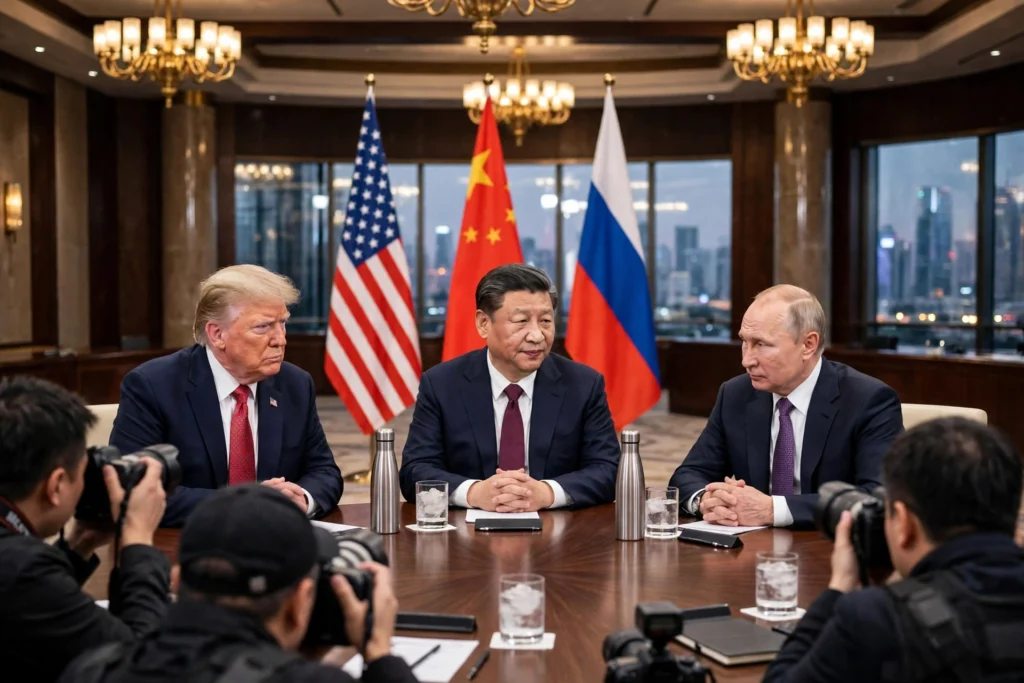
United States President Donald Trump, Chinese President Xi Jinping and Russian President Vladimir Putin are meeting in Shenzhen on Thursday for the first-ever trilateral summit of the leaders of the world’s three major powers, on the sidelines of the Asia-Pacific Economic Cooperation (APEC) forum. The unprecedented gathering is expected to focus on nuclear arms control, the wars in Ukraine and Iran, trade tensions and artificial intelligence — though experts have kept expectations low for any major breakthrough.
Key Takeaways
- The Shenzhen meeting is the first face-to-face trilateral summit ever held between the leaders of the United States, China and Russia.
- Trump held a one-on-one meeting with Putin and a bilateral meeting with Xi before the three leaders sat down together on Thursday afternoon.
- Nuclear arms control tops the agenda after the US–Russia New START treaty expired in February 2026; Trump wants a new three-way agreement including China.
- The wars in Ukraine and Iran, global trade and AI regulation are also expected to dominate the discussions.
- Trump told the APEC summit the United States opposes “any form of globalist regulation” of artificial intelligence, vowing: “We won’t allow that to happen.”
- Officials have been negotiating a draft joint statement, but it remains unclear whether the three sides will adopt one.
Update: Leaders adopt joint ‘Declaration Toward Peace’
The three leaders adopted a joint declaration after around 90 minutes of talks at Kylin Villa in Shenzhen on Thursday. The document, titled ‘The Russia-China-US Heads of State Declaration Toward Peace’, was released by the Kremlin and Chinese state media. It sets out four commitments: the three countries, as permanent members of the United Nations Security Council, will promote reform of the UN so it can respond more effectively to global challenges; they will increase the production and supply of refined petroleum products, reaffirming the importance of stable energy flows; they recognised the principle of state consent and respect for the immunities of state officials, and agreed that the International Criminal Court and similar bodies must not abuse their jurisdiction; and they reaffirmed that a nuclear war cannot be won and must never be fought, agreeing to hold a dialogue on reducing nuclear risks and preventing the proliferation of nuclear weapons. The declaration made no mention of the wars in Ukraine or Iran, despite President Trump saying he had raised both conflicts during the discussions. Dmitry Peskov, President Putin’s spokesman, said Ukraine was not the main topic of the meeting. The declaration sets out no specific targets, timelines or mechanisms for implementing its commitments, and announces no agreement on nuclear disarmament.
A first in modern diplomacy
Chinese President Xi Jinping is hosting the summit in Shenzhen, the southern Chinese tech hub, where leaders gathered this week for the 33rd APEC Economic Leaders’ Meeting. It is the first time the heads of state of China, Russia and the United States have met together face to face, a fact China’s Foreign Ministry highlighted ahead of the talks. Beijing said the three leaders would have “an in-depth exchange of views on global peace”, calling the summit one of the most significant diplomatic events of the year.
The symbolism was clear even before the meeting began. In an unusual gesture, Xi personally received Trump at Shenzhen Bao’an International Airport on Wednesday, in what was seen as a return of the courtesy Trump showed in September, when he broke decades of US protocol and greeted Xi at the aircraft during the Chinese leader’s visit to Washington. The welcome included a fighter-jet flyover trailing rainbow-coloured smoke. Ahead of the APEC gala reception on Wednesday evening, the three leaders exchanged greetings and spoke briefly, a moment Russian media described as a prelude to Thursday’s main event.
On Thursday morning, Xi opened the leaders’ summit, with the visiting dignitaries gathered around circular tables in a large conference room under chandeliers. Moments before the plenary session, they posed for a group photograph with Xi in the centre, flanked by Putin and Trump. Trump then met Putin one-on-one, telling him: “We’ve had a great relationship for many years.” The bilateral meeting between Trump and Xi — their third substantial meeting this year — followed, with the trilateral session scheduled for the afternoon.
What is on the agenda
Trump has said he wants the trilateral talks to explore nuclear arms reductions, and the issue carries new urgency after the New START treaty between the United States and Russia expired in February 2026. Trump has expressed interest in negotiating a new nuclear arms control agreement involving Washington, Moscow and Beijing. US officials said the three leaders would likely discuss the war in Ukraine, the situation in Iran, global energy stability and nuclear arms control.
The meeting comes at a sensitive moment for the international order. The Ukraine war continues, tensions with Iran are running high in the Gulf, and the three powers are divided over trade, technology and the future of global governance. Some commentators have compared the gathering to the 1945 Yalta Conference, where the leaders of the United States, Britain and the Soviet Union redrew the post-war order — a comparison that underlines how much is at stake, and how far apart the three sides remain.
The talks also follow US-mediated peace talks between Russia and Ukraine held in Abu Dhabi last week, the first such negotiations in nine months. Kremlin foreign policy aide Yuri Ushakov said on Monday that the three countries were engaged in intensive consultations over a draft joint statement, adding that Russia had conveyed its position to China. It remains unclear whether the three sides will adopt a joint statement at all.
Trump’s message on AI
Addressing the APEC summit on Thursday, Trump used the gathering to set out the United States’ position on artificial intelligence, saying Washington opposes “any form of globalist regulation or anything to control or stifle” the technology. “We won’t allow that to happen,” he said, defending the AI industry against regulations that could slow its growth. He described superintelligence as the greatest technological transformation since the Industrial Revolution and claimed the United States was leading the world in the field.
The remarks set up a clear point of difference with China and Russia, both of which have called for international rules governing AI. Trump said he looked forward to a “historic trilateral meeting” with Xi and Putin later in the day, framing the gathering as a chance to explore shared opportunities. “And here in China, I look forward to a historic trilateral meeting with President Xi and President Putin later today to discuss more opportunities for all three,” he said.
Low expectations, high symbolism
For all the historic framing, analysts and officials have been careful to manage expectations. The Hindu’s live coverage noted that the meeting “could mark a pivot in world history — or become a quickly forgotten photo op”, and experts have kept expectations low for major breakthroughs, given the deep differences between the three countries on Ukraine, Iran, trade and arms control.
What is not in doubt is the significance of the image itself: the leaders of the three most powerful countries in the world, seated together for the first time. Xi and Putin held their own bilateral discussions on Wednesday ahead of Trump’s arrival, with Xi vowing to defend free trade and Putin saying sanctions had failed and that he expected “big benefit” from the trilateral. For Beijing, hosting the gathering is itself a statement — a chance to present China as the convenor of great-power diplomacy.
What happens next
The trilateral session is expected to last no more than about an hour, after which the leaders will return to the APEC programme. Whether a joint statement emerges, and what it says about nuclear arms, Ukraine and Iran, will be the first test of whether the meeting produced anything beyond the photograph. Officials from all three governments will also be watched for readouts in the hours after the talks, and for any sign of follow-up meetings. For now, the Shenzhen summit stands as a first — the first time the leaders of the United States, China and Russia have sat down together — and the world will be watching what, if anything, follows.
Frequently Asked Questions
Why is the Trump–Xi–Putin meeting historic?
It is the first-ever face-to-face trilateral summit between the leaders of the United States, China and Russia. The three heads of state have never met together before, and the gathering brings the world’s three major powers to the same table at a time of war in Ukraine, confrontation with Iran and the expiry of the New START nuclear treaty.
What is on the agenda for the trilateral summit?
Nuclear arms control is the central issue, with Trump seeking a new three-way agreement after New START expired in February 2026. The leaders are also expected to discuss the wars in Ukraine and Iran, global trade, energy stability and artificial intelligence.
Will the three leaders issue a joint statement?
Officials have been negotiating a draft joint statement, and Kremlin aide Yuri Ushakov said Russia had conveyed its position to China. But it remains unclear whether the three sides will adopt one, and experts have kept expectations low for major breakthroughs.
Sources
- The Tribune, “Big Three converge in Shenzhen for ‘mini Yalta’”, 19 November 2026
- Times of India, “‘We won’t allow that to happen’: Trump warns against AI curbs at APEC; Xi, Putin talks in focus”, 19 November 2026
- Korea Times, “Trump, Xi, Putin set to hold historic trilateral summit; US-N. Korea meeting uncertain”, 19 November 2026
- Nikkei Asia, “APEC live: Xi opens summit; flanked by Putin, Trump in ‘family photo’”, 19 November 2026
- The Hindu, “Xi-Trump-Putin trilateral meeting LIVE”, 19 November 2026