
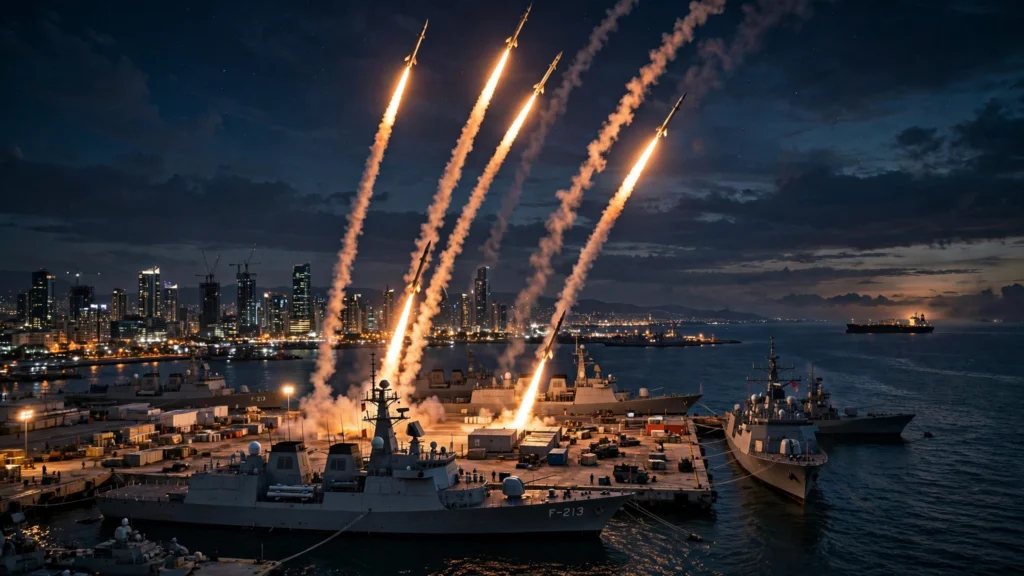
Iran widened its attacks across the Gulf on Wednesday, firing drones at a United States airbase in Kuwait and launching fresh strikes on Bahrain, while a tanker was hit by an unknown projectile near Oman in the latest attack on shipping in the Strait of Hormuz. Gulf states scrambled to intercept the incoming fire a day after American jets struck an Iranian missile site, in what mediators are calling a “dangerous escalation” of a conflict that began in February.
Key Takeaways
- Iran’s military said its drones targeted Patriot air defence systems and missile and drone launch platforms at Ali Al-Salem Air Base in Kuwait on Wednesday.
- Kuwait’s army said its air defences responded to the drone threat; Bahrain said it intercepted a further wave of Iranian attacks early on Wednesday — its fourth in six days.
- A tanker was struck by an unknown projectile in its engine room about 6 nautical miles north of Khasab, Oman, in the Strait of Hormuz on Wednesday evening.
- The United States reissued security warnings to its citizens in Bahrain and Saudi Arabia, and the Gulf Cooperation Council condemned the attacks.
- Qatar, which has been mediating with Iranian officials, called the latest attacks a “dangerous escalation”.
- Neither Kuwait nor Bahrain immediately reported damage or casualties from Wednesday’s attacks.
Kuwait targeted as Iran widens the fight
Iran’s army said on Wednesday that its drones had struck United States military assets at Ali Al-Salem Air Base in Kuwait, according to a statement carried by state broadcaster IRIB. The statement said “combat and kamikaze drones” targeted Patriot air defence systems and drone and missile launch platforms belonging to the US military at the base, in what appeared to be retaliation for US strikes the day before.
Kuwait’s military said its air defences were “responding to hostile drone threats” and urged the public to follow safety advice. It was the first time since early September that Kuwait had activated its air defences against such an attack. Neither country immediately reported damage or casualties. The attack marked a significant widening of the conflict: Iran had previously concentrated its fire on Bahrain and on shipping in the Strait of Hormuz, but Wednesday’s strikes brought a third Gulf state directly into the line of fire.
The strikes came a day after the United States hit an Iranian missile launch site on Qeshm Island, in the Strait of Hormuz, with precision munitions. A US military official described that action as a “self-defense” strike, saying it was a riposte to an Iranian strike on a US radar installation in Bahrain earlier on Tuesday. Iran responded by striking America’s wealthy Gulf allies, which host US military bases, and by continuing its campaign against shipping through Hormuz, which before the war carried a quarter of global oil flows.
Bahrain hit for a fourth time in six days
Bahrain said its air defences intercepted Iranian attacks early on Wednesday, a day after Tehran’s Revolutionary Guards said they had targeted a US base on the island nation. Bahrain’s armed forces said they “confronted, intercepted and destroyed a number of treacherous Iranian aerial attacks today… before they could achieve their objectives”, while Iran’s Revolutionary Guards said they had targeted a US-operated radar system at the Sheikh Isa Air Base.
It was the fourth Iranian attack on Bahrain in six days, ending a weeks-long respite in a war that started with US–Israeli strikes on Iran on 28 February. Bahrain, home to the US Navy’s Fifth Fleet, had been heavily targeted earlier in the conflict but had escaped strikes for weeks before Iranian drone attacks on Friday and Sunday. Iran’s Revolutionary Guards also warned Bahrain’s monarchy that its survival was at risk amid a push to “evict” the US Fifth Fleet, according to Fox News reporting.
Bahrain’s Civil Defense evacuated a multi-storey building in the capital’s Souq Waqif area as a precaution and extinguished a fire that broke out in the building, according to the Interior Ministry, which had issued a warning at 3:45 a.m. on Wednesday. The United States reissued its security warning to American citizens in Bahrain and Saudi Arabia on Wednesday, after both countries came under attack from Iran and its allies.
Tanker struck near Oman
A tanker was struck by an unknown projectile in its engine room while sailing outbound through the Strait of Hormuz, prompting a maritime security warning, according to the United Kingdom Maritime Trade Operations (UKMTO). The incident occurred approximately 6 nautical miles north of Khasab, Oman, at 4:45 p.m. UTC (8:45 p.m. Gulf time) on Wednesday, 18 November. UKMTO issued an incident alert at 2:30 a.m. on Thursday following a delayed report from local authorities.
The attack is the latest in a series against commercial shipping in the world’s most important oil chokepoint. On Tuesday evening, an ADNOC Logistics & Services vessel was attacked while transiting the Strait of Hormuz, leaving one crew member missing and 11 injured, while the Panama-flagged LPG tanker Tara Gas was also struck, with one crew member missing and 24 rescued by Oman. The United States military has been working to escort ships transiting the waterway in defiance of Tehran’s attempts to close it.
Regional condemnation and warnings
The Gulf Cooperation Council’s Secretary-General, Jasem Mohamed Albudaiwi, condemned the latest Iranian drone attack on Kuwait, and the Council of Arab Interior Ministers condemned what it called Iranian acts of aggression against Saudi Arabia, Bahrain and Kuwait, as well as the attack on a United Arab Emirates oil tanker. The United Arab Emirates “condemned in the strongest terms” the renewed Iranian attack on Bahrain.
Qatar, which held talks with Iranian officials on Tuesday, called the latest attacks a “dangerous escalation”. Iran’s army chief, Amir Hatami, warned of a “more devastating” reaction to the United States and its allies. The Houthis, Iran’s allies in Yemen, attacked Saudi Arabia again on Wednesday, and the Saudi-led coalition said it dealt with a missile threat launched towards Riyadh after a loud boom was heard in the Saudi capital.
Meanwhile, US President Donald Trump has renewed his warning that he intends to end the conflict with Iran “one way or the other”, and says he wants a “lasting” deal. Reports in Israel say Trump is weighing another major offensive against Iran, with Prime Minister Benjamin Netanyahu pushing Washington to join Israel in a four- to seven-day campaign of airstrikes. Trump told Fox News on Wednesday that there was an “indication” Iran was looking at biological weapons, but also indicated a US strike may not be imminent. “We are going to have a new year coming up, and we will see what happens after January 1,” he said.
What happens next
The Gulf is on high alert, with air defences active across Bahrain, Kuwait and Saudi Arabia and the US military escorting shipping through Hormuz. The immediate question is whether the tit-for-tat strikes continue to escalate or whether diplomacy — including Qatar’s mediation and the talks expected at the APEC summit in Shenzhen, where Iran is on the agenda — can open a path to de-escalation. With a third Gulf state now targeted, commercial shipping under attack and warnings of a “more devastating” Iranian response, the region’s governments and the millions of people living under the flight paths of these drones will be watching the skies closely.
Frequently Asked Questions
What happened in the Gulf on Wednesday?
Iran fired drones at Ali Al-Salem Air Base in Kuwait and launched fresh attacks on Bahrain, while a tanker was hit by an unknown projectile near Oman in the Strait of Hormuz. Kuwait and Bahrain both said their air defences intercepted the attacks, and neither country immediately reported damage or casualties.
Why is Iran attacking Gulf states?
Iran says the attacks are retaliation for US strikes, including Tuesday’s American strike on a missile launch site on Iran’s Qeshm Island. The wider conflict began on 28 February with US–Israeli strikes on Iran, and Iran has responded by striking Gulf states that host US military bases and by attacking shipping through the Strait of Hormuz.
How are Gulf states and the US responding?
Gulf air defences in Bahrain, Kuwait and Saudi Arabia have been intercepting the attacks, the GCC has condemned them, and the United States has reissued security warnings to its citizens in Bahrain and Saudi Arabia. The US military is also escorting ships through the Strait of Hormuz, while Qatar continues mediation efforts with Iranian officials.
Sources
- Gulf News, “Gulf Crisis Deepens: Iran Targets Bahrain, ADNOC Vessel Attacked, US Responds with Strikes”, 19 November 2026
- Malay Mail (AFP), “‘Dangerous escalation’: Gulf nations scramble to intercept fire from Iran, allies after US strikes on Qeshm Island”, 19 November 2026
- China Daily, “Gulf tensions intensify as Iran, US trade strikes”, 19 November 2026
- The Nation, “Iran attacks Kuwait, Bahrain, further escalating fight over Strait of Hormuz”, 19 November 2026
- Times of Israel, liveblog, 19 November 2026
Pingback: Three Oil Tankers Hit Mines in Strait of Hormuz, Iran Says