
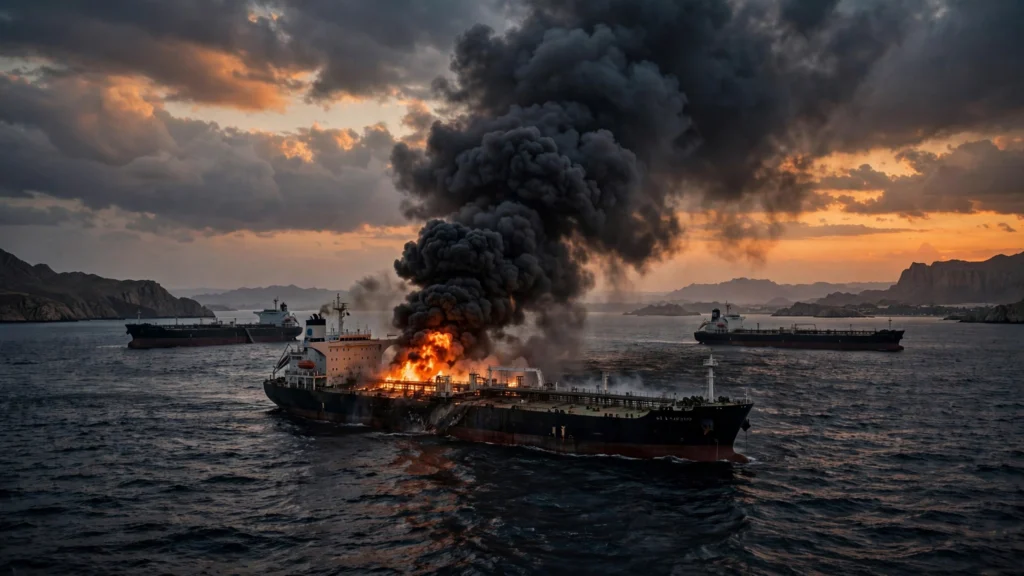
Three oil tankers caught fire and were disabled after hitting naval mines east of the Strait of Hormuz on Wednesday, Iran’s military said, in the latest attack on shipping in the world’s most important oil waterway.
Iran’s Army Navy said the three vessels had ignored warnings from its naval forces, switched off their navigation systems and entered an area it described as prohibited to shipping before striking the mines, according to statements carried by Iranian state media. The tankers were left unable to continue sailing. Iran’s Islamic Revolutionary Guard Corps (IRGC) said passage through the strategic waterway must now be coordinated with Iranian authorities.
The names, flags and crews of the three tankers have not been disclosed, and no casualties have been reported. The Iranian claims could not be independently verified.
Key Takeaways:
- Iran’s military says three oil tankers hit naval mines east of the Strait of Hormuz on Wednesday and caught fire, leaving all three disabled.
- Tehran says the vessels ignored warnings, switched off their navigation systems and entered a prohibited area; it says passage through the waterway must be coordinated with Iranian authorities.
- No vessel names, flags, crews or casualties have been disclosed, and the claims have not been independently verified.
- The incident is separate from a tanker hit by an unknown projectile near Oman on Tuesday, and at least five vessels have now been hit in or near the Strait in recent days.
- The attacks come in the ninth month of the war that began on 28 February 2026, a day after the United States struck an Iranian missile site on Qeshm Island and Iran’s attacks on Kuwait and Bahrain on Wednesday.
- The United States has tightened its naval blockade of Iran with new curbs on oil transfers at sea, and now has three carrier strike groups in the region.
What Iran says happened
Iran’s Army Navy announced on Wednesday that three oil tankers had caught fire after striking naval mines in the eastern part of the Strait of Hormuz, according to the official IRNA news agency. The statement said the vessels had violated maritime regulations, ignored warnings issued by the Iranian Navy, switched off their navigation systems and entered a prohibited area east of the strait before hitting the mines.
Iran’s state-run Press TV first reported the Iranian Navy’s account on Wednesday. The IRGC, in a statement carried by the state broadcaster IRIB, said the tankers had been operating in restricted areas despite warnings from Iranian naval forces and that passage through the waterway must be coordinated with Iranian authorities. Al Jazeera reported the IRGC’s account, which was then carried by outlets including NDTV and Al Arabiya.
Iran’s military also warned ships against taking what it described as “fake American routes” through the waterway, and claimed to have shot down two United States drones in separate incidents over the Strait of Hormuz. Neither claim has been independently verified.
What is not yet confirmed
Important details remain missing. Neither the Iranian Navy nor the IRGC has identified the three tankers, their flags, their owners or their crews, and no information has been released about injuries or deaths. No independent shipping or maritime-security source has confirmed that three tankers were mined, and no photographs or video of the three vessels have been independently verified.
That caution matters because the Strait of Hormuz has become a theatre of competing claims in recent days. Iran’s account should be read as the statement of a party to the conflict, not as an independently confirmed fact. This article will be updated if the vessels are identified or if independent confirmation emerges.
A separate tanker attack near Oman
The three tankers are not the same vessel as the tanker struck a day earlier near Oman. The United Kingdom Maritime Trade Operations (UKMTO) said a tanker was hit by an unknown projectile in its engine room while sailing outbound through the Strait of Hormuz, about six nautical miles north of Khasab, Oman, at 16:45 UTC on Tuesday 18 November. That incident, covered in our earlier report, prompted a maritime security warning.
Separately, an ADNOC vessel was attacked in the Strait of Hormuz, leaving one crew member missing and 11 injured, according to Al Arabiya, and the crew of a gas tanker abandoned their vessel off Oman after it was hit by a projectile. Taken together, at least five vessels have now been hit in or near the Strait in recent days, according to NDTV’s tally of the reported incidents.
The wider Gulf war in its ninth month
The mine incidents are part of a sharp escalation in a war that began on 28 February 2026, when the United States and Israel launched joint strikes on Iran. Iran has responded by striking America’s wealthy Gulf allies, which host US military bases, and by blockading the Strait of Hormuz, which carried about a quarter of global oil flows before the war.
On Tuesday, American fighter jets struck an IRGC missile launch site on Iran’s Qeshm Island with precision munitions, which a US military official described as a self-defence strike in response to Iranian aggression against US forces and assets. A local official on Qeshm Island was quoted in Iranian media as saying the island had been hit by several US strikes that caused no damage to infrastructure.
On Wednesday, Iran’s army said its combat and kamikaze drones targeted US air defence systems and missile and drone launch platforms at Ali Al-Salem Air Base in Kuwait — Tehran’s first attack on the US-allied Gulf state since September. Kuwait said its air defences intercepted the drones. Bahrain said it intercepted a further wave of Iranian attacks early on Wednesday, its fourth in six days. The Saudi-led coalition said it intercepted Houthi cruise missiles and drones fired towards Saudi Arabia, and destroyed Houthi targets in Yemen. The Gulf Cooperation Council condemned the attacks, and the United States reissued security warnings for its citizens in Bahrain and Saudi Arabia.
Shipping, oil and the blockade
The Strait of Hormuz is the narrow channel between Iran and Oman through which a large share of the world’s seaborne oil and liquefied natural gas passes. Any sustained threat to shipping there raises insurance costs, forces vessels to reroute or wait, and puts upward pressure on energy prices. Oil prices have stayed high and volatile through the escalation.
Washington has tightened its naval blockade of Iran with new curbs on oil transfers at sea, according to a US advisory reported by Reuters. Three US carrier strike groups are now operating in the region after the USS Theodore Roosevelt arrived in the US Central Command area on Sunday 15 November, joining the USS George H.W. Bush and the USS George Washington. The Arab League has condemned the attack on the ADNOC vessel.
What happens next
Three questions will decide how serious this incident becomes. First, whether the three tankers are identified and their crews accounted for. Second, whether shipping companies and insurers treat the eastern Strait as a mined area and suspend or reroute transits, which would deepen the disruption to oil flows. Third, whether the United States and its Gulf allies respond to the mining of the waterway, which would mark a further escalation in a conflict that has already spread from Iran to Bahrain, Kuwait and Saudi Arabia in a single week.
The United States has said it wants a “lasting” deal to end the conflict, while Iran’s army chief has warned of a “more devastating” response if Iran is attacked again. For now, the Strait of Hormuz — the artery of the global oil trade — is the most dangerous stretch of water in the world.
What happened to the three oil tankers near the Strait of Hormuz?
Iran’s military says three oil tankers caught fire and were disabled after hitting naval mines east of the Strait of Hormuz on Wednesday. Tehran says the vessels ignored warnings, switched off their navigation systems and entered a prohibited area. The vessels have not been named and the claims have not been independently verified.
Is this the same as the tanker attacked near Oman?
No. The UK Maritime Trade Operations centre reported a separate incident in which a tanker was hit by an unknown projectile in its engine room about six nautical miles north of Khasab, Oman, on Tuesday 18 November. At least five vessels have now been reported hit in or near the Strait in recent days.
Why does the Strait of Hormuz matter?
The Strait of Hormuz is the narrow waterway between Iran and Oman through which a large share of the world’s seaborne oil and liquefied natural gas passes. Before the war it carried about a quarter of global oil flows, so attacks or mining there disrupt energy supplies, raise shipping and insurance costs, and push up oil prices.
Sources:
- Al Arabiya English, “Three oil tankers catch fire after hitting naval mines east of Strait of Hormuz: Report”, 19 Nov 2026 — https://english.alarabiya.net/News/middle-east/2026/11/19/three-oil-tankers-catch-fire-after-hitting-naval-mines-east-of-strait-of-hormuz-report
- NDTV, “3 Oil Tankers Catch Fire After Hitting Mines East Of Strait Of Hormuz: Iran”, 19 Nov 2026 — https://www.ndtv.com/world-news/3-oil-tankers-catch-fire-after-hitting-mines-east-of-strait-of-hormuz-iran-12346597/amp/1
- IRNA, “Three violating vessels catch fire after striking naval mines in Strait of Hormuz: Iran’s Army Navy”, 19 Nov 2026 — https://en.irna.ir/news/86326369/Three-violating-vessels-catch-fire-after-striking-naval-mines
- Türkiye Today, “Iran says 3 oil tankers struck naval mines, caught fire in Strait of Hormuz”, 19 Nov 2026 — https://www.turkiyetoday.com/region/iran-says-3-oil-tankers-struck-naval-mines-caught-fire-in-strait-of-hormuz-3232734
- Gulf News, “Middle East Escalates: Houthi Missile Intercepted, Tanker Hit, Iran Strikes Kuwait and Bahrain”, 19 Nov 2026 — https://gulfnews.com/world/mena/middle-east-war-houthi-missile-intercepted-over-saudi-arabia-tanker-hit-in-hormuz-iran-strikes-kuwait-and-bahrain-as-trump-demands-lasting-deal-1.500752996