
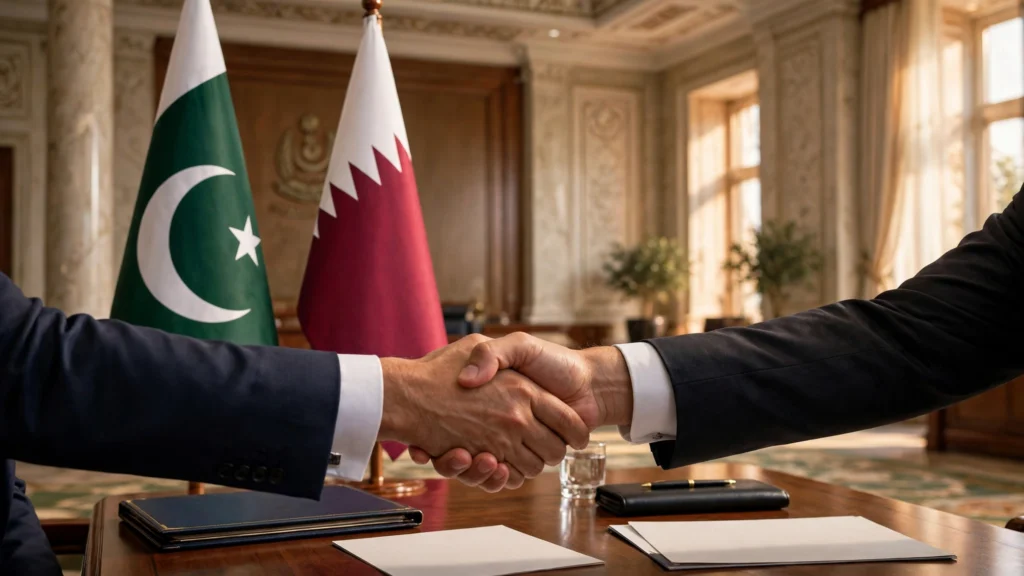
Pakistan and Qatar signed a memorandum of understanding on security cooperation and a joint action plan against drug smuggling on Thursday, deepening a partnership that now spans policing, cybercrime, counterterrorism and narcotics enforcement. The agreements were signed in Islamabad in a ceremony witnessed by Prime Minister Shehbaz Sharif, during the first visit to Pakistan by Qatar’s interior minister, Sheikh Khalifa bin Hamad bin Khalifa Al Thani.
The security cooperation memorandum was signed between Qatar’s Internal Security Force, known as Lekhwiya, and Pakistan’s Federal Constabulary. The two countries also agreed to expand their police officers’ exchange programme and to strengthen cooperation between Qatar’s National Cyber Security Agency and Pakistan’s National Cyber Crime Investigation Agency. Qatar will build a modern firing range at Pakistan’s National Police Academy and supply modern scanners to the Anti-Narcotics Force.
The visit comes at a tense moment for the region. Pakistan and Qatar have both been working to mediate an end to the war between the United States and Iran, a conflict that began with US and Israeli strikes on Iran in February and has repeatedly disrupted shipping through the Strait of Hormuz. Thursday’s security agreements were announced separately from those diplomatic efforts, but they underline how closely the two countries are now coordinating on regional security.
Key Takeaways
- Pakistan and Qatar signed a security cooperation MoU between Qatar’s Lekhwiya force and Pakistan’s Federal Constabulary, plus an action plan against drug smuggling, on Thursday 19 November in Islamabad.
- Prime Minister Shehbaz Sharif witnessed the signing; Interior Minister Mohsin Naqvi and his Qatari counterpart, Sheikh Khalifa bin Hamad bin Khalifa Al Thani, signed the documents.
- The two sides agreed to expand the police officers’ exchange programme and deepen cooperation between Qatar’s National Cyber Security Agency and Pakistan’s National Cyber Crime Investigation Agency.
- Qatar will build a modern firing range at the National Police Academy and supply scanners to the Anti-Narcotics Force; joint operations have busted 300 drug cases over four years, according to Naqvi.
- Qatar’s interior minister also met Chief of Defence Forces and Army Chief Field Marshal Asim Munir, with both sides reaffirming counterterrorism cooperation.
- The full text of the MoU has not been made public, so the specific obligations it creates have not been disclosed beyond the official statements.
What was signed in Islamabad
The signing took place after a meeting between Prime Minister Shehbaz Sharif and the visiting Qatari minister, who also commands Lekhwiya. According to a statement from the Prime Minister’s Office, the prime minister witnessed the signing of the memorandum of understanding on security cooperation between the Internal Security Force of Qatar and the Federal Constabulary of Pakistan, as well as the action plan on the fight against drugs.
Interior Minister Mohsin Naqvi and Sheikh Khalifa signed on behalf of their respective sides. The prime minister also hosted a luncheon in honour of the visiting delegation. The visit followed talks between the two interior ministers in Doha in October, when they had already agreed to expand cooperation on internal security.
Shehbaz Sharif welcomed the Qatari minister on his first visit to Pakistan and reaffirmed what the Prime Minister’s Office described as the longstanding brotherly relations between the two countries. He expressed the hope that the visit would further strengthen cooperation between the interior ministries and institutions of both countries, and conveyed his greetings to the Amir of Qatar.
Police exchanges and cybercrime cooperation
In a separate one-on-one meeting followed by delegation-level talks, Naqvi and Sheikh Khalifa agreed to expand the scope of the police officers’ exchange programme, allowing officers from each country to train and work alongside their counterparts. The two sides also agreed to enhance cooperation between Qatar’s National Cyber Security Agency and Pakistan’s National Cyber Crime Investigation Agency, reflecting the growing importance of cybercrime in both countries’ security agendas.
“A decision was made to improve coordination between the two interior ministries to enhance bilateral cooperation,” the interior ministry said in a statement. Naqvi described cybercrime as an international problem and said Pakistan was taking robust measures to combat it.
The practical side of the cooperation is concrete. Qatar will establish a modern firing range at the National Police Academy, and Naqvi thanked Qatar for providing modern scanners to the Anti-Narcotics Force. Joint operations and information-sharing between the relevant agencies of the two countries are already under way, according to the ministry.
The fight against drug smuggling
The anti-drug action plan is the most operationally detailed part of Thursday’s agreements. Naqvi said that with joint cooperation between Pakistan and Qatar, 300 drug cases have been busted over the past four years. “We want to ensure that our territory is never used for drug smuggling,” he said.
Pakistan sits on one of the world’s major narcotics transit routes, and drug smuggling through the region has long been linked to organised crime and militant financing. The action plan, alongside the new scanners for the Anti-Narcotics Force, is intended to tighten detection at borders and transit points. The precise measures in the plan have not been published, and the memorandum’s text has not been made public — so the obligations the two sides have taken on should not be assumed to go beyond what the official statements describe.
Counterterrorism and the military dimension
The security partnership also has a military dimension. Sheikh Khalifa met Chief of Defence Forces and Chief of the Army Staff Field Marshal Asim Munir in Rawalpindi, where the two sides reaffirmed their commitment to strengthening bilateral cooperation in security, counterterrorism and institutional matters.
According to a statement from Inter-Services Public Relations, the meeting covered matters of mutual interest, the evolving regional and global security situation, and avenues for enhancing security cooperation. The meeting underlined that the Qatar relationship is not only a civilian policing matter but part of a broader security dialogue between the two states.
A relationship built on energy, workers and mediation
The security agreements sit on top of a much wider relationship. During Thursday’s meeting, Prime Minister Shehbaz thanked Qatar for its continued supply of liquefied natural gas, which he said was helping meet Pakistan’s energy requirements — a supply that has become more important as disruption around the Strait of Hormuz threatens a route that carried roughly a fifth of the world’s traded oil and LNG before the conflict.
The prime minister also noted that around 300,000 Pakistanis were working in Qatar and making meaningful contributions to its development, and said there was considerable potential to enhance economic cooperation in trade and investment, agriculture, livestock, information technology, mines and minerals.
Both countries have also been active mediators in the US–Iran war. A Pakistan-brokered accord briefly halted the fighting in June and laid out a path towards reopening the Strait of Hormuz, but the truce subsequently collapsed. Iran has proposed reopening the strait within two days if Washington meets its conditions, including easing sanctions, releasing frozen Iranian assets and ending the US naval blockade of Iranian ports. Deputy Prime Minister and Foreign Minister Ishaq Dar said on Monday that Washington had yet to respond, while Qatar said on Tuesday that it was continuing its mediation efforts and planned talks with Iranian officials.
What happens next
The agreements signed on Thursday are framework documents: a memorandum of understanding and an action plan, not a treaty with published terms. Their practical effect will depend on how the police exchange programme, the cybercrime cooperation and the anti-drug measures are implemented in the coming months. The firing range at the National Police Academy and the scanners for the Anti-Narcotics Force are the first tangible deliverables, and both sides will be judged on whether the cooperation produces measurable results — in drug seizures, in cybercrime cases and in the counterterrorism coordination both governments have promised.
For now, the visit has done what it was designed to do: it has put Pakistan–Qatar security cooperation on a formal footing, at a moment when both countries are trying to manage a war on their doorstep and keep a vital energy corridor open.
Frequently Asked Questions
What did Pakistan and Qatar sign on 19 November 2026?
Pakistan and Qatar signed a memorandum of understanding on security cooperation between Qatar’s Internal Security Force (Lekhwiya) and Pakistan’s Federal Constabulary, plus an action plan on the fight against drugs. The signing was witnessed by Prime Minister Shehbaz Sharif in Islamabad.
What practical measures were agreed?
The two sides agreed to expand the police officers’ exchange programme, deepen cooperation between Qatar’s National Cyber Security Agency and Pakistan’s National Cyber Crime Investigation Agency, build a modern firing range at the National Police Academy, and supply scanners to the Anti-Narcotics Force. Joint operations have busted 300 drug cases over four years, according to Interior Minister Mohsin Naqvi.
Is the full text of the agreement public?
No. The MoU text has not been made public, so the specific obligations it creates have not been disclosed beyond what the Prime Minister’s Office and interior ministry statements say.
Sources
- Dawn — “Pakistan, Qatar sign security pact, vow stronger counterterror ties”
- Pakistan Today — “Pakistan and Qatar sign a security pact and anti-drug plan”
- Dawn — “Pakistan, Qatar reaffirm commitment to strengthening bilateral relations in security, counter-terrorism: ISPR”
- Gulf Times — “Qatar, Pakistan enhance security ties”