
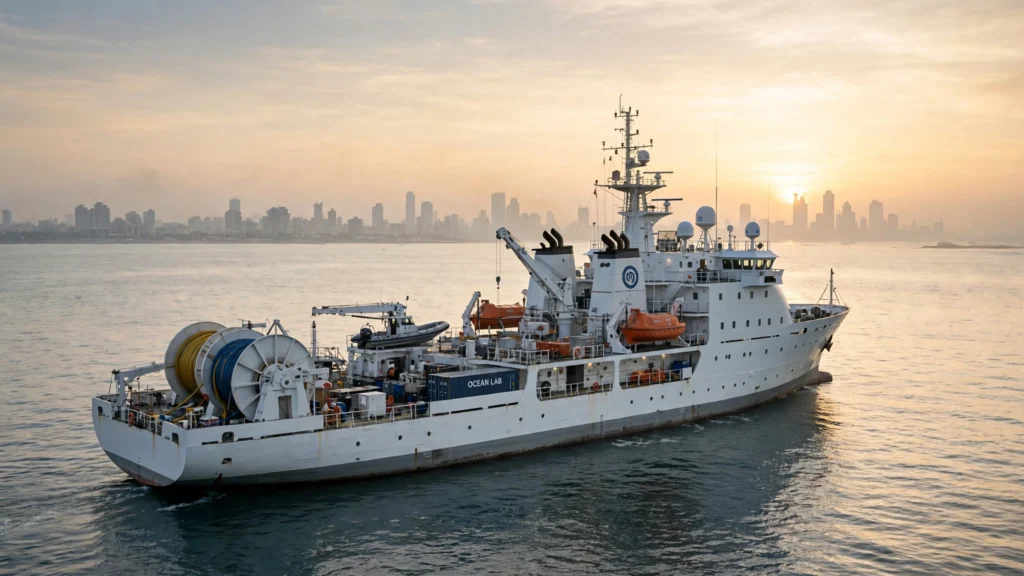
Pakistan and Türkiye have begun offshore oil and gas exploration in the Arabian Sea, with the Turkish seismic research vessel Oruç Reis starting surveys of the Indus and Makran basins on Friday. The two countries are targeting the first offshore drilling by the fourth quarter of 2027, after the survey data has been assessed — the first serious offshore exploration push in Pakistan in 18 years.
Key Takeaways
- Türkiye’s seismic research vessel Oruç Reis arrived at Karachi port on Thursday after a 19-day voyage, and was formally welcomed at a ceremony on Friday attended by Deputy Prime Minister Ishaq Dar and Turkish Energy Minister Alparslan Bayraktar.
- The vessel will collect 3D seismic data across 670 square kilometres in the Eastern Offshore Indus-C Block over about two months, followed by 2D surveys along 2,353 kilometres of survey lines in the Makran offshore blocks.
- Data acquisition and interpretation are expected to be completed within six months, paving the way for drilling in late 2027.
- Turkish Petroleum Overseas Company, a subsidiary of Türkiye’s state oil company TPAO, is the operator of Indus-C with a 25 per cent stake, alongside Pakistan Petroleum Ltd (35 per cent), OGDCL (20 per cent) and Mari Energies (20 per cent).
- The companies have committed around $80 million in initial exploration spending over three years.
- Deputy Prime Minister Ishaq Dar put Pakistan’s untapped natural wealth at $8 trillion to $10 trillion — but both governments stressed that seismic surveys do not guarantee commercial discoveries.
A 19-day voyage ends in Karachi
The Oruç Reis arrived at Karachi port on Thursday, completing a 19-day voyage from Türkiye, and was formally welcomed at a ceremony on the shores of the Arabian Sea on Friday. Deputy Prime Minister and Foreign Minister Ishaq Dar, Sindh Governor Nehal Hashmi, Sindh Chief Minister Murad Ali Shah and Federal Minister for Petroleum Ali Pervaiz Malik attended, with Türkiye’s Minister of Energy and Natural Resources Alparslan Bayraktar as guest of honour. Addressing the ceremony, Petroleum Minister Malik said the arrival of the vessel was more than a routine port call, calling it a critical turning point for the revitalisation of Pakistan’s offshore oil and gas exploration. Bayraktar said Türkiye was committed to using its technical expertise, scientific experience and engineering capabilities for Pakistan’s benefit, and that cooperation in the energy sector was entering a new era. The launch revives exploration in the Eastern Offshore Indus-C Block and marks a new phase in Pakistan–Türkiye energy cooperation. Pakistan’s offshore exploration has been largely dormant for nearly two decades: in January 2025 the country launched its first offshore bidding round in 18 years, offering 40 offshore blocks. Turkish officials say licensing has since been completed on five blocks — three offshore in the Indus and Makran basins and two onshore — with TPAO leading the exploration effort alongside Pakistan’s national energy companies. A day earlier, a Turkish delegation led by Bayraktar called on Prime Minister Muhammad Shehbaz Sharif in Islamabad. The prime minister said exploring potential oil and gas reserves in Pakistan’s maritime boundaries was an important step for the country’s energy security and economic development, and thanked Turkish President Recep Tayyip Erdogan for the vessel’s arrival and Türkiye’s full cooperation in the project.
What the surveys will cover
The Oruç Reis, built in Türkiye in 2017 and about 87 metres long, is Türkiye’s flagship domestically engineered seismic research vessel. It arrives in Pakistani waters fresh from its first intercontinental assignment off Somalia, where it mapped 4,464 square kilometres of seabed. In Pakistan, the vessel will run a two-part survey programme over roughly two and a half months. First, the Marjan 3D Seismic Project in the Indus-C Block off Karachi, collecting high-resolution 3D seismic data across 670 square kilometres over approximately 50 days. Then it will move west to the Makran Basin off Balochistan, spending about 25 days collecting 2D seismic data along 2,353 kilometres of survey lines, creating wide cross-sectional maps of a geological frontier that remains largely underexplored. Data acquisition and interpretation are expected to be completed within six months. Bayraktar said that based on the data collected, the partners aim to begin drilling at designated sites next year — with the formal target, announced on Friday, of first drilling operations by the fourth quarter of 2027.
Who holds what in Indus-C
The Eastern Offshore Indus-C Block is at the centre of the initiative. Turkish Petroleum Overseas Company (TPOC), a wholly owned subsidiary of the Turkish Petroleum Corporation (TPAO), is the operator with a 25 per cent working interest. Pakistan Petroleum Limited holds 35 per cent, Oil and Gas Development Company Limited 20 per cent and Mari Energies the remaining 20 per cent. The participating companies have committed around $80 million in initial exploration expenditure over three years. According to Pakistan Petroleum Ltd, which previously conducted two- and three-dimensional surveys in the area, the Indus-C Block is estimated to contain 1.5 trillion to 2 trillion cubic feet of gas — an estimate from earlier surveys, not a confirmed reserve. Malik said Türkiye’s participation had significantly expanded bilateral petroleum cooperation through agreements covering three offshore and two onshore blocks, and that Pakistan’s offshore basins held significant geological potential, although large areas remained underexplored.
The $8–10 trillion claim — and the caveats
Speaking at the Karachi ceremony, Deputy Prime Minister Dar said Pakistan possessed vast natural resources, including minerals, hydrocarbons, gemstones and rare earth materials, and put the country’s natural wealth at an estimated $8 trillion to $10 trillion at the “most conservative estimate” — far exceeding the country’s external debt burden. He said Pakistan sought a long-term energy partnership with Türkiye encompassing offshore exploration, minerals and renewable energy. But Dar also acknowledged that offshore exploration was complex, capital-intensive and inherently uncertain, and that seismic surveys did not guarantee commercial discoveries. Malik sounded the same note, cautioning that surveys were an essential first step in identifying potential hydrocarbon resources, not a promise of them. The caution matters. Seismic data can show where oil and gas might be trapped beneath the seabed, but only drilling can confirm whether a find is commercially viable — and offshore wells are among the most expensive in the energy industry. Pakistan has drilled offshore before without a commercial discovery, which is one reason the sector went quiet for so long.
Why it matters for Pakistan’s energy security
For Pakistan, the stakes are straightforward. The country imports most of its oil and gas, and its energy import bill is a chronic strain on foreign exchange reserves. A domestic offshore find would not transform that picture overnight — even on the most optimistic timetable, drilling would not begin until late 2027 and production would be years further out — but it would change the long-term outlook. The partnership also deepens a relationship that has been widening beyond energy. Pakistan and Türkiye signed three agreements on mineral exploration and development alongside the offshore work, and the two countries concluded a security pact with Qatar earlier this week. Bayraktar’s visit, and the prime minister’s public thanks to President Erdogan, underline how central the energy file has become to the bilateral relationship. Türkiye, for its part, brings experience it has built up rapidly at home: it says it now has the fourth-largest deepwater drilling fleet, produces around 10 million cubic metres of natural gas a day from its Black Sea fields, and aims to raise that to around 40 million cubic metres a day by 2028. The Oruç Reis deployment is only the vessel’s second overseas mission. At home, the latest petrol price cut offers more immediate relief at the pump, while the offshore programme looks years ahead. The energy push also follows other recent national developments, including Pakistan test-fires Fatah-3 supersonic cruise missile.
What happens next
Over the next two months, the Oruç Reis will work the Indus-C Block, then shift to Makran. Once the surveys are complete, supercomputers will need months to process and interpret the acoustic readings before the partners choose drilling locations. If the data is promising, the first wells could be drilled in the final quarter of 2027. If it is not, the partners will have spent around $80 million to learn that — which is precisely the point of a seismic survey. For now, the significance is that after 18 years of dormancy, Pakistan’s offshore is being explored again, with a partner that has both the ships and the recent track record to do the work.
What has Pakistan and Türkiye actually started?
Seismic surveys of Pakistan’s offshore Indus and Makran basins. Türkiye’s research vessel Oruç Reis arrived in Karachi on Thursday and will collect 3D seismic data across 670 square kilometres in the Indus-C Block over about two months, followed by 2D surveys in the Makran blocks. Drilling is targeted for the fourth quarter of 2027, after the data is assessed.
Who is running the exploration, and what are the stakes?
Turkish Petroleum Overseas Company, a subsidiary of Türkiye’s state oil company TPAO, is the operator of the Indus-C Block with a 25 per cent stake, alongside Pakistan Petroleum Ltd (35 per cent), OGDCL (20 per cent) and Mari Energies (20 per cent). The companies have committed around $80 million in initial exploration spending over three years.
Has Pakistan found oil or gas?
No. Seismic surveys map the geology beneath the seabed; they do not confirm reserves. Pakistan Petroleum Ltd has previously estimated the Indus-C Block could contain 1.5 trillion to 2 trillion cubic feet of gas, but only drilling can confirm a commercial discovery. Both governments have stressed that surveys do not guarantee a find.
Sources:
- Dawn, “Pakistan, Turkiye kick off offshore oil, gas exploration”, 21 Nov 2026 — https://www.dawn.com/news/2046031
- Dawn, “Nation’s mineral wealth worth $8-10tr: Dar”, 21 Nov 2026 — https://www.dawn.com/news/2046026/nations-mineral-wealth-worth-8-10tr-dar
- The Nation, “Pakistan resumes offshore oil, gas exploration after 18 years with Türkiye’s Oruç Reis vessel”, 21 Nov 2026 — https://www.nation.com.pk/21-Nov-2026/pakistan-resumes-offshore-oil-gas-exploration-18-years-t-rkiye-s-oru-reis-vessel
- The News, “Offshore push vital for energy security: PM”, 21 Nov 2026 — https://www.thenews.pk/print/1449990-offshore-push-vital-for-energy-security-pm