
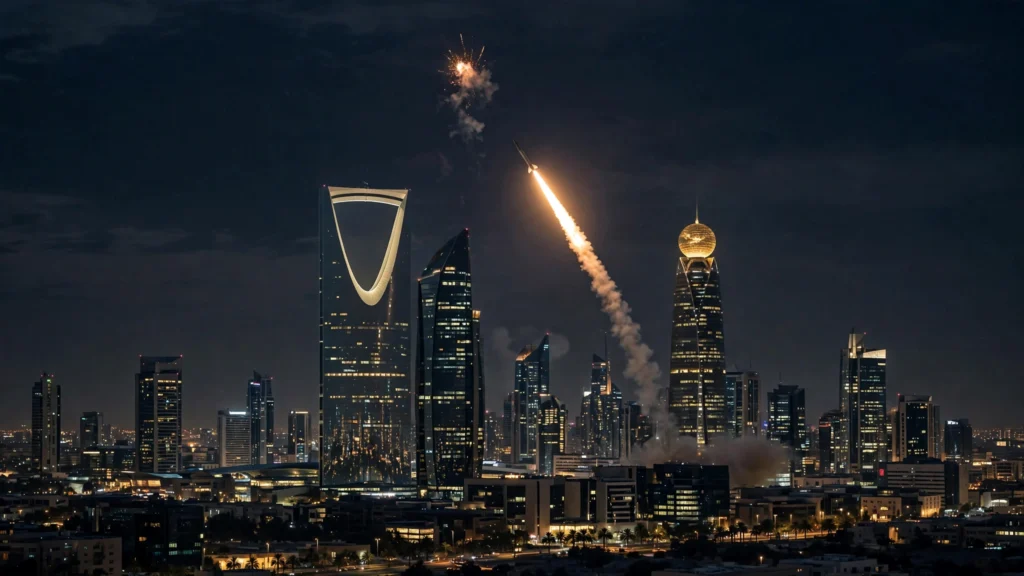
Saudi air defences intercepted three Houthi ballistic missiles fired towards Riyadh in the early hours of Saturday, the Saudi-led coalition said, hours before two oil tankers were hit by unidentified projectiles near the Strait of Hormuz — a sharp escalation on two fronts of the US–Iran war on the same morning. It was the third consecutive day of Houthi attacks on the Saudi capital, coming two days after a missile damaged Riyadh’s tallest skyscraper.
Key Takeaways
- The Saudi-led coalition said it intercepted and destroyed three ballistic missiles fired by Yemen’s Houthis towards Riyadh early on Saturday, after civil defence issued an aerial-threat alert for the capital at 1:53 a.m.
- Two explosions were heard in Riyadh, an AFP journalist reported, and a Reuters witness saw a projectile streak across the sky before a loud bang; the alert was later lifted.
- Hours later, the coalition said it destroyed another Houthi drone fired towards the kingdom’s south.
- Two tankers sailing out of the Strait of Hormuz were hit by unidentified projectiles off Khasab, Oman, on Saturday morning, less than an hour apart — one on the stern, one in the engine room. No casualties were reported in either incident, the UK Maritime Trade Operations agency said.
- Iran’s foreign minister said Tehran could reopen the Strait of Hormuz “on the second day” if Washington meets its commitments on the first, while President Donald Trump said the US has “total control” over the waterway.
- The US Treasury announced new sanctions on Friday against Iranian oil traders and facilitators, part of an operation it calls Economic Outcast.
Three missiles over Riyadh in the early hours
Saudi Arabia’s civil defence issued an emergency alert for Riyadh at 1:53 a.m. on Saturday, warning residents of an “aerial threat”. Shortly after 2 a.m., the spokesman for the Saudi-led coalition, Major General Turki Al-Maliki, announced on X that air defences had “intercepted and destroyed (3) ballistic missiles launched by the terrorist Houthi militia toward Riyadh”.
An AFP journalist in the capital reported hearing two explosions shortly after the alert. A Reuters witness saw a projectile streak across the sky in Riyadh shortly before hearing a loud bang, leaving a trail of smoke. Civil defence later lifted the alert, saying the danger had passed.
The attack was the second on the Saudi capital in a few days and the third day running that the Houthis have targeted Riyadh. On Thursday, a Houthi missile struck the 80-storey PIF Tower in Riyadh’s King Abdullah Financial District, blowing out windows across seven to eight floors. On Friday morning, the coalition said it intercepted five drones and one ballistic missile fired by the rebels, with Riyadh among the targets, and struck Houthi weapons-smuggling targets in the port of Hodeidah and military sites in Sanaa.
Hours after Saturday’s interceptions, the coalition said it had destroyed another drone fired by the Houthis towards the kingdom’s south. The Houthis had earlier threatened to strike Saudi Arabia’s financial centre and Red Sea ports, including Jeddah.
Two tankers hit off Oman within the hour
While Riyadh was still counting the cost of the overnight attack, shipping in the Gulf came under fire again. The United Kingdom Maritime Trade Operations (UKMTO) agency said two tankers sailing outbound through the Strait of Hormuz were hit by unidentified projectiles off Khasab, Oman, on Saturday morning, less than an hour apart.
The first tanker was struck on its stern at about 5 a.m. UTC, roughly 11 nautical miles north of Khasab. At about 5:50 a.m. UTC, a second outbound tanker was hit in its engine room about 17 nautical miles east of Khasab. No casualties were reported in either incident, and the environmental impact was still unconfirmed, UKMTO said, citing military authorities. The agency urged vessels to transit with caution while authorities investigate.
The attacks followed a tanker being struck by an unknown projectile near the same area on Friday, when the vessel’s company security officer reported a fire on board. Iran’s Revolutionary Guards said shortly afterwards that a tanker had caught fire after hitting a mine while attempting to transit the strait near Khasab, according to Iranian state media.
Khasab lies on Oman’s Musandam Peninsula at the entrance to the Strait of Hormuz, a waterway that carried nearly one-fifth of the world’s crude oil supplies before the US–Israeli war with Iran began on 28 February. Shipping through the strait has been disrupted since Iran moved to close the waterway, and remains about 65 per cent below pre-war levels, according to UKMTO.
A strike near Qeshm Island and new US sanctions
The overnight escalation followed a fresh American strike near Iran on Friday evening. The US carried out a missile strike on the outskirts of Qeshm city, on Iran’s strategic Qeshm Island in the Strait of Hormuz, at around 6:50 p.m. local time on Friday, according to Iran’s Tasnim news agency. The strike came after Iran fired a surface-to-air missile at a US Air Force F-16 over Qeshm Island, following an earlier anti-ship missile launch targeting US Navy-escorted vessels in the strait.
Iranian state media also reported that the Revolutionary Guards had shot down a US MQ-9 drone over the Strait of Hormuz, the 58th such drone it claims to have downed. The claim could not be independently verified.
Also on Friday, the US Treasury Department announced new sanctions against Iranian oil traders and government-linked facilitators it accused of helping Tehran sell oil abroad, as part of an operation it calls Economic Outcast. “Iran’s tyrannical regime never fails to put its own interests before those of its own citizens, even as ordinary Iranians face shortages of bread and fuel,” Treasury Secretary Scott Bessent said.
Hormuz: Tehran’s terms, Trump’s “total control”
Diplomacy, meanwhile, remains stalled over the waterway itself. Iranian Foreign Minister Abbas Araghchi told the state-owned Iran newspaper that Tehran could reopen the Strait of Hormuz “on the second day” if Washington fulfils its commitments on the first day, framing the choice as resting “entirely” with the United States. He said the Islamabad memorandum of understanding between Tehran and Washington was no longer on the table, but that the commitments in it — combined with demands including the lifting of new US sanctions — had been turned into a plan under which Iran would reopen the strait and negotiations would begin.
Tehran has laid down seven conditions before it will agree to a ceasefire and the reopening of the strait, including the lifting of the US naval blockade on Iranian ports, sanctions relief, the release of frozen Iranian funds, an end to hostilities on all fronts and a formal declaration that the war is over. The US has not formally responded to the terms, and Secretary of State Marco Rubio has described Iran’s demands as “unacceptable”.
Speaking at a White House press conference on Friday, President Donald Trump said the United States has “total control” over the Strait of Hormuz. “Last week, we took out record amounts of oil from the Hormuz Strait. Our navy has a blockade. We have total control over the Hormuz Strait,” he said. Trump also said Iran wants a deal but not one “acceptable” to him, adding: “We want to make a real deal, not a fake deal.”
What happens next
Saturday’s twin escalation — missiles over a Gulf capital and tankers hit at the mouth of the world’s most important oil chokepoint — shows the war widening even as both sides talk about a deal. Saudi Arabia has warned it will not tolerate attacks on its territory or national assets and has urged the permanent members of the UN Security Council to condemn the attacks. The coalition’s strikes on Hodeidah and Sanaa on Friday suggest it will keep hitting Houthi launch and smuggling sites in response.
For shipping, the question is whether Saturday’s two tanker strikes — the fourth and fifth attacks on vessels near Khasab in three days — push more operators to avoid the strait altogether, deepening a disruption that has already cut transits by about two-thirds. For diplomacy, the gap remains wide: Tehran wants its seven conditions met before the strait reopens, Washington says it already controls the waterway and wants a deal on its own terms, and Trump has said he will “see what happens” on Iran after 1 January.
What happened in Riyadh early on Saturday?
The Saudi-led coalition said it intercepted and destroyed three Houthi ballistic missiles fired towards Riyadh early on Saturday, after civil defence issued an aerial-threat alert at 1:53 a.m. Two explosions were heard in the capital, and the alert was later lifted. It was the third consecutive day of Houthi attacks on Riyadh.
What happened to the two tankers near the Strait of Hormuz?
Two tankers sailing out of the Strait of Hormuz were hit by unidentified projectiles off Khasab, Oman, on Saturday morning, less than an hour apart — the first on its stern at about 5 a.m. UTC, the second in its engine room at about 5:50 a.m. UTC. No casualties were reported, UKMTO said, and the environmental impact was unconfirmed.
What are Iran’s conditions for reopening the Strait of Hormuz?
Iran’s foreign minister said Tehran could reopen the strait “on the second day” if Washington meets its commitments on the first. Tehran’s seven conditions include lifting the US naval blockade, sanctions relief, releasing frozen Iranian funds, ending hostilities on all fronts and formally declaring the war over. President Trump says the US already has “total control” over the waterway.
Sources:
- Al Jazeera, “Saudi-led coalition intercepts three Houthi missiles headed for Riyadh”, 21 Nov 2026 — https://www.aljazeera.com/news/2026/11/21/saudi-led-coalition-intercepts-three-houthi-missiles-headed-for-riyadh
- Arab News, “Coalition air defenses intercept 3 Houthi ballistic missiles targeting Riyadh”, 21 Nov 2026 — https://www.arabnews.com/saudi-arabia/coalition-air-defenses-intercept-3-houthi-ballistic-missiles-targeting-riyadh-3013264
- Reuters (via Channel News Asia), “Saudi Arabia says it intercepts three missiles targeting Riyadh”, 21 Nov 2026 — https://www.channelnewsasia.com/world/saudi-arabia-yemen-houthi-missiles-riyadh-6571176
- Reuters, “Tanker hit by unknown projectile near Oman’s Khasab, UKMTO says”, 21 Nov 2026 — https://www.reuters.com/business/energy/tanker-hit-by-unknown-projectile-near-omans-khasab-ukmto-says-2026-11-21/
- The Jerusalem Post, “Two tankers attacked in Strait of Hormuz near Oman, UKMTO says”, 21 Nov 2026 — https://www.jpost.com/middle-east/article-915628
- Gulf News, “US-Israel War on Iran Escalates: Saudi Faces Houthi Missiles Amid Trump’s Delayed Decision”, 21 Nov 2026 — https://gulfnews.com/world/mena/us-israel-war-on-iran-saudi-faces-houthi-missiles-trump-delays-iran-decision-1.500754425
- Türkiye Today, “Araghchi says Iran still bets on diplomacy as Trump rejects Tehran’s terms”, 21 Nov 2026 — https://www.turkiyetoday.com/region/araghchi-says-iran-still-bets-on-diplomacy-as-trump-rejects-tehrans-terms-3232882
- Dawn live blog, “War returns to Iran with Israel, US strikes”, 21 Nov 2026 — https://www.dawn.com/live/iran-israel-war