
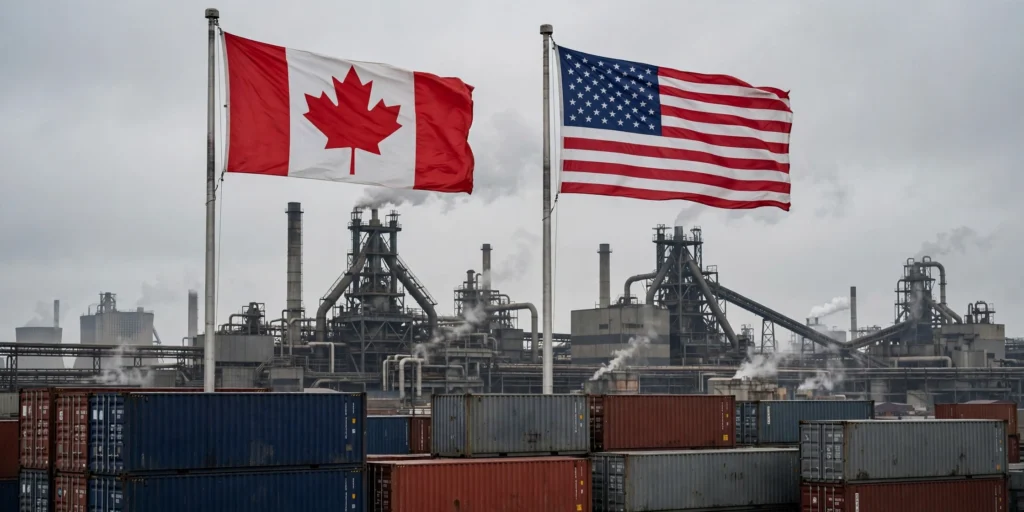
Canada is still seeking an interim deal with the United States to ease some of the tariffs on its goods, but Washington has shown little movement, trade minister Dominic LeBlanc told a federal advisory committee on Thursday. With US tariffs on Canadian steel, autos and lumber set to rise in January to 50 per cent from 25 per cent, Ottawa is running out of time to reach even a partial agreement before the end of the year.
Key Takeaways
- Trade minister Dominic LeBlanc told the Advisory Committee on Canada-US Economic Relations on Thursday that Washington has shown “little movement” on tariff relief, according to two people familiar with the briefing.
- US tariffs on Canadian steel, autos and lumber are set to rise in January to 50 per cent from 25 per cent.
- Canadian companies and industry associations have warned the increase could dismantle decades-old supply chains and lead to job losses and factory shutdowns.
- LeBlanc said he is in regular contact with US Commerce Secretary Howard Lutnick and US Trade Representative Jamieson Greer, but there has been little progress since talks broke down in August.
- Prime Minister Mark Carney met US President Donald Trump for about 20 minutes on the sidelines of the APEC summit in Shenzhen on 18 November, with no trade breakthrough.
- The US midterm elections, in which the Democrats took control of the House of Representatives and the Senate, have not changed the course of the trade negotiations.
The briefing: little movement after months of talks
Canada is still seeking an interim arrangement with the United States to ease some US tariffs on its goods, but Washington has shown little movement, the Canadian minister responsible for trade with the US, Dominic LeBlanc, told an advisory committee on Thursday, two people familiar with the briefing said. LeBlanc told the Advisory Committee on Canada-US Economic Relations, which includes business leaders and politicians, that he is in regular contact with his US counterparts, but there has been little progress since talks broke down in August, the people said. They spoke on condition of anonymity because the briefing was private.
LeBlanc’s office confirmed in a statement that he had briefed the committee on the trade talks and reaffirmed Canada’s commitment to strike a mutually beneficial agreement with the US. Speaking to CBC News after the briefing, LeBlanc said Ottawa had made some progress in the talks with Washington, but not enough to sign a deal. “We’re not yet at a point where we think we have a deal that is good enough for the economic interests of the country, but we have made progress,” he said.
The January deadline — and what is at stake
US tariffs on Canadian steel, autos and lumber are set to rise in January to 50 per cent from 25 per cent. Companies and industry associations have warned Prime Minister Mark Carney’s government that the increase could dismantle decades-old supply chains and lead to job losses and factory shutdowns.
The tariffs at issue are the sectoral duties imposed under Section 232 of US trade law, which lets the president restrict imports deemed a threat to national security, including those on steel and autos, as well as the separate tariffs imposed on Canadian goods in August after the earlier talks collapsed.
In August, Trump imposed 50 per cent tariffs on about US$20 billion worth of goods from Canada, and Canada retaliated with counter-tariffs on a similar value of US products. Ottawa is seeking relief from the Section 232 tariffs on steel, aluminium, autos and lumber, along with the tariffs imposed in August. LeBlanc cautioned, however, that even with a deal, the US would likely keep some sectoral tariffs on Canadian steel and autos. “I think we have to be realistic with Canadians in those particular sectors; there is an element of those tariffs that are going to remain, but they have to be in a circumstance that … the long-term economic viability of these sectors is assured,” he told CBC News.
Carney’s meeting with Trump at APEC
The briefing came a day after Carney met Trump on the sidelines of the APEC summit in Shenzhen, China, on Wednesday 18 November. The meeting lasted about 20 minutes, was unscheduled, and was the first sit-down between the two leaders since July. The Prime Minister’s Office said afterwards that the two leaders discussed working toward a trade agreement, but the discussion ended without a trade breakthrough.
Carney said at the DealBook Summit on Wednesday that talks had made progress in recent weeks, though the two sides had yet to put anything in writing. Ottawa is aiming for an interim tariff agreement with the Trump administration before the end of the year, with nothing yet put in writing and no formal package announced by either side.
The government believes a window exists to reach a deal before the end of the year, ahead of the Democrats taking control of Congress. The US midterm elections, in which President Donald Trump’s Republican Party lost control of the House of Representatives and the Senate to the Democrats, have not changed the course of trade negotiations, one of the people familiar with the briefing said.
Who LeBlanc is talking to in Washington
One of the people familiar with the briefing said LeBlanc has been speaking with US Commerce Secretary Howard Lutnick, whose department plays a central role in administering and negotiating tariffs imposed under the Section 232 national-security law, including those on steel and autos. LeBlanc has also been speaking with US Trade Representative Jamieson Greer, who led most of the dialogue in August before the talks collapsed.
The Commerce Department’s central role matters because the sectoral tariffs are administered through it, putting Lutnick rather than the Trade Representative’s office at the centre of the negotiations.
Canada’s wider trade strategy
The stalled US talks stand in contrast to Canada’s progress elsewhere in the region this week. At the same APEC summit in Shenzhen, Carney secured tariff cuts from China — a deal Ottawa has presented as part of a broader effort to diversify Canada’s trade away from its heavy dependence on the United States.
That diversification has limits. The United States remains by far Canada’s largest trading partner, and the integrated auto and steel supply chains built up over decades cannot be rerouted quickly. Industry groups have been blunt about the consequences if the January increase goes ahead without relief: production lines that cross the border several times before a finished vehicle rolls off the line would face a 50 per cent duty at each crossing, a cost structure no manufacturer can absorb for long.
For now, Ottawa’s message is that talks continue and that some progress has been made — but not enough, and not fast enough, to give Canadian businesses the certainty they need before January. The wider summit context is covered in our report on the leaders’ meeting.
What happens next
The immediate test is whether the two sides can put anything in writing before the end of the year. LeBlanc’s office has said Canada remains committed to a mutually beneficial agreement, and Carney has said his position has not shifted since the talks collapsed in August. Washington, for its part, has given no public sign that it is prepared to move.
If no interim deal is reached, Canadian steel, auto and lumber exporters will face the higher 50 per cent rate from January, with the job losses and factory shutdowns industry groups have warned about becoming a live risk rather than a forecast. If a partial deal is reached, it will still leave some sectoral tariffs in place — a compromise LeBlanc has already begun preparing Canadians for.
What tariffs is Canada trying to get relief from?
Canada is seeking relief from US tariffs on steel, autos and lumber, which are set to rise in January to 50 per cent from 25 per cent, as well as the tariffs imposed on Canadian goods in August after trade talks broke down.
Why have the Canada-US trade talks stalled?
Talks broke down in August, and trade minister Dominic LeBlanc told an advisory committee on Thursday that Washington has shown little movement since, despite regular contact between LeBlanc and US Commerce Secretary Howard Lutnick and Trade Representative Jamieson Greer.
Did Carney’s meeting with Trump at APEC change anything?
No. Carney met Trump for about 20 minutes on the sidelines of the APEC summit in Shenzhen on 18 November, but the discussion ended without a trade breakthrough, and nothing has been put in writing.
Sources:
- Reuters, “Canada sees little US movement on tariff relief, sources say“, 19 Nov 2026
- Free Malaysia Today (Reuters), “Canada sees little US movement on tariff relief“, 20 Nov 2026
- The True Post, “Canada Sees Little US Movement on Tariff Relief as January Hike Looms“