
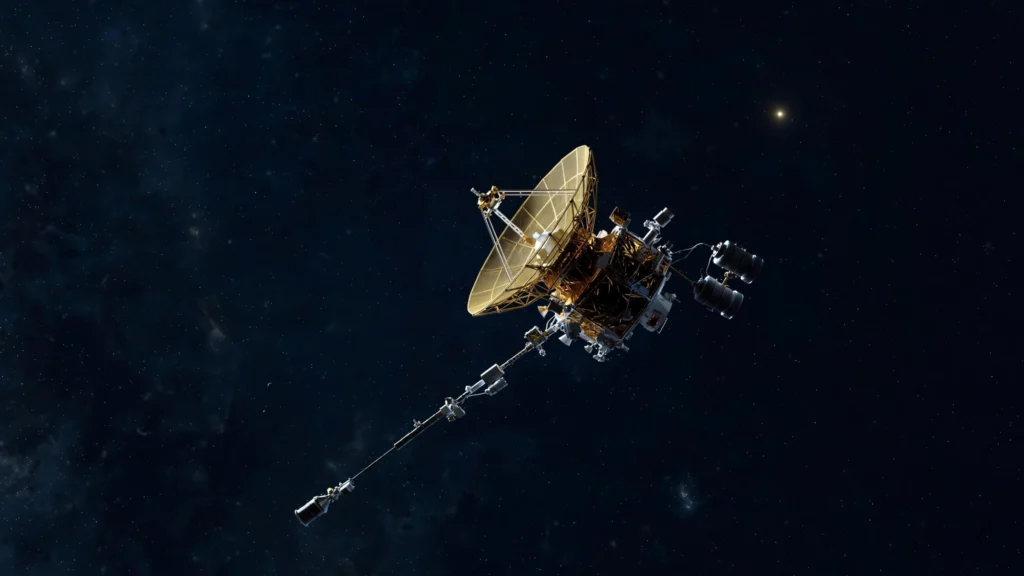
NASA’s Voyager 1 has become the first human-made object ever to travel one light-day from Earth, crossing the milestone just after 5:16 a.m. ET on Wednesday 18 November, nearly 50 years after it left the planet. One light-day is the distance light travels in 24 hours — roughly 16 billion miles, or 26 billion kilometres. A radio signal now takes a full day to reach it, and another full day for the reply to return. No spacecraft has ever been farther from home. “It’s never happened before, and it may never happen again — it’s that kind of extraordinary,” said Kareem Badaruddin, Voyager mission manager at NASA’s Jet Propulsion Laboratory in Pasadena, California.
Key Takeaways
- Voyager 1 crossed one light-day from Earth — about 26 billion km — just after 5:16 a.m. ET on Wednesday 18 November 2026, the first human-made object ever to do so.
- A radio signal now takes 24 hours to reach the spacecraft and another 24 hours to return: a two-day round trip.
- Launched on 5 September 1977, Voyager 1 was built for a five-year mission to Jupiter and Saturn; it has now been flying for 49 years.
- It crossed into interstellar space in August 2012 and has been the farthest human-made object since 1998, when it passed Pioneer 10.
- Only two of its ten original scientific instruments are still operating, and its plutonium power supply fades by about 4 watts a year.
- The probe is heading toward the star Gliese 445, more than 17 light-years away, and will pass within about 1.7 light-years of it in around 40,000 years.
What one light-day means
A light-day is a measure of distance defined by speed: how far light, the fastest thing in the universe, can travel in a single day. At roughly 300,000 kilometres per second, that works out to about 25.9 billion kilometres — the figure Voyager 1 reached on Wednesday. The scale is hard to grasp. Light from the Sun takes about eight minutes to reach Earth; the Moon is just over a second away at light speed. Voyager 1 is now a full day away, and the gap grows by about 1.5 million kilometres every 24 hours as the probe races onward at roughly 38,000 miles per hour (61,155 km/h). NASA scientist Tiffany Kataria put the achievement in perspective: it is “the best illustration of just how vast space is”. It took Voyager 1 nearly half a century to reach the edge of our own solar system, she noted — and many star systems astronomers dream of visiting are several light-years away.
A two-day phone call
Voyager 1 is still in contact with Earth through NASA’s Deep Space Network, a set of giant radio antennas spread around the globe — but the conversation now moves at a pace unlike anything else in human engineering. “If you called someone on the other side of the Earth, the phone signal — traveling at light speed — would take less than one-tenth of a second to reach them,” Badaruddin explained. With Voyager 1, “it literally takes 24 hours for them to get to it”. “Operating a remote device with a round-trip communication time of two days requires a totally different mindset than any other operational scenario I can imagine,” said William Kurth, a University of Iowa research scientist who has worked on Voyager since 1974. The fragility of that link was underlined only weeks ago, when NASA lost contact with the probe for two days in late October before the link restored itself — a reminder that the spacecraft is operating on very thin margins. Even technology billions rely on daily can fail without warning — Apple’s iCloud went down this week after an internal update — and Voyager 1 has no repair crew, no spare parts and no second chance if a critical system fails.
Built for five years, still flying after 49
Voyager 1 lifted off from Cape Canaveral on 5 September 1977 aboard a Titan IIIE-Centaur rocket. Its twin, Voyager 2, launched in August the same year. Both were built to last just five years and to fly past Jupiter and Saturn — a mission made possible by a rare alignment of the outer planets that let the probes use their gravity to accelerate onward. Voyager 1 flew past Jupiter in 1979 and Saturn in 1980, returning the first close-up images of the giant planets and their moons. Its cameras revealed active volcanoes on Jupiter’s moon Io and helped scientists understand the atmosphere of Saturn’s largest moon, Titan. In 1990, at the suggestion of astronomer Carl Sagan, Voyager 1 turned its camera back toward home and took the famous “Pale Blue Dot” photograph — Earth as a tiny speck of light, seen from about 3.7 billion miles away. The cameras were switched off later that year and have never been used again. In August 2012, Voyager 1 crossed the heliopause — where the solar wind gives way to the space between the stars — becoming the first human-made object to enter interstellar space. Voyager 2 followed in 2018. The two are the only spacecraft ever to operate beyond the Sun’s protective bubble, the heliosphere. Voyager 1 has been the farthest human-made object since 1998, when it overtook Pioneer 10, an earlier NASA probe that has long since fallen silent.
Running on fading power
The Voyagers are still alive thanks to a power source that needs no sunlight. Each probe carries three radioisotope thermoelectric generators, which use the heat from decaying plutonium-238 to produce electricity. But the output falls every year as the plutonium breaks down and the hardware ages. At launch, Voyager 1’s generators supplied 470 watts — roughly the power of a small household blender. The probe now loses about 4 watts a year and is producing roughly 210 watts. To keep it going, NASA engineers have progressively switched off systems, and only two of the ten original scientific instruments are still running: the magnetometer, which measures magnetic fields, and the plasma wave subsystem, which studies the density of charged particles. This summer, engineers performed a daring reshuffle of the power distribution — turning off three power-hungry devices and turning on three others that together used less power, keeping heat distributed so the propellant lines stayed warm enough not to freeze. The team called the change the “Big Bang”, because everything happened at once, using seven power commands that had never been used in flight. “It’s going to save us 10 watts, so it bought us about two and a half years of power,” Badaruddin said. Even so, the end is in sight. For decades, mission managers have estimated the Voyagers might last three to five more years, and NASA hopes Voyager 1 will keep communicating into the early 2030s, before its power drops below the minimum needed to run anything at all.
The Golden Record
Both Voyagers carry the Golden Record, a 12-inch gold-plated copper disc holding images, natural sounds, music and spoken greetings in 55 languages, plus messages from former US President Jimmy Carter and former UN Secretary-General Kurt Waldheim. The record was designed as a portrait of Earth — what humanity is, what it sounds like, what it values — sealed in a spacecraft that will outlast every building, every hard drive and every person alive today. To mark the milestone, NASA invited people around the world to shine lights into the sky after sunset on Tuesday, flashing the letters “VGR” — Voyager’s call sign — in Morse code.
Where Voyager 1 goes next
Voyager 1 is heading toward Gliese 445, a star more than 17 light-years away in the constellation Ursa Minor, and will pass within roughly 1.7 light-years of it in about 40,000 years. It is not travelling there to explore it; the star simply lies in the direction the probe happens to be going. Voyager 2 is expected to reach one light-day in 2035, if it is still operating by then. Voyager 1 is one of five spacecraft on trajectories that leave the solar system; Pioneer 10 and Pioneer 11 are also heading out but stopped communicating long ago, and New Horizons is travelling through the Kuiper Belt beyond Neptune. NASA Administrator Jared Isaacman marked the moment on X: “Voyager 1 is now one light-day from Earth, an extraordinary NASA achievement for a spacecraft assembled by human hands and launched nearly 50 years ago.”
Why it matters
The milestone is partly symbolic, but it is also scientific. No telescope can do what Voyager 1 does: it is actually inside the interstellar medium, measuring its gas, dust, magnetic fields and charged particles directly, rather than observing them from light-years away. “We use telescopes to study the interstellar medium from Earth,” Badaruddin said, “but there’s a huge difference between having a device actually in the medium you’re studying versus studying it from a distance.” It is also a reminder of what patient engineering can do: a spacecraft built with 1977 technology, designed for five years, is still sending useful science back after 49, and its mission reaches its 50th anniversary next year. Back on Earth, it has been a week of technology firsts too — Grand Theft Auto VI launches today. But nothing built this week will still be working in 2075. Voyager 1 might be.
What is one light-day?
One light-day is the distance light travels in 24 hours — roughly 16 billion miles (26 billion kilometres). Voyager 1 reached that distance from Earth on Wednesday 18 November 2026, becoming the first human-made object ever to do so.
How long does a signal take to reach Voyager 1?
A radio signal sent from Earth now takes a full 24 hours to reach Voyager 1, and its reply takes another 24 hours to come back — a two-day round trip. NASA communicates with the probe through its Deep Space Network of large ground-based radio antennas.
How much longer can Voyager 1 keep working?
That is uncertain. Its plutonium power supply fades by about 4 watts a year, and only two of its ten original instruments are still running. NASA hopes it will keep communicating into the early 2030s. Voyager 2 is expected to reach one light-day in 2035, if it is still operating.
Sources:
- CNN — “Voyager 1, the farthest human-made object, is now one light-day from Earth”, 18 Nov 2026
- Al Jazeera — “NASA’s Voyager 1 hits record one light-day distance, 50 years after launch”, 18 Nov 2026
- The Times — “Nasa’s Voyager 1 travels ‘light day’ from Earth in interstellar first”, 18 Nov 2026
- ScienceAlert — “Voyager 1 Has Sped Through Space at 38,000 Mph Since 1977. This Wednesday, It Will Finally Reach 1 Light-Day From Earth”, 17 Nov 2026
- Mathrubhumi English — “Voyager 1 reaches one light-day from earth; A journey into the infinite”, 19 Nov 2026