
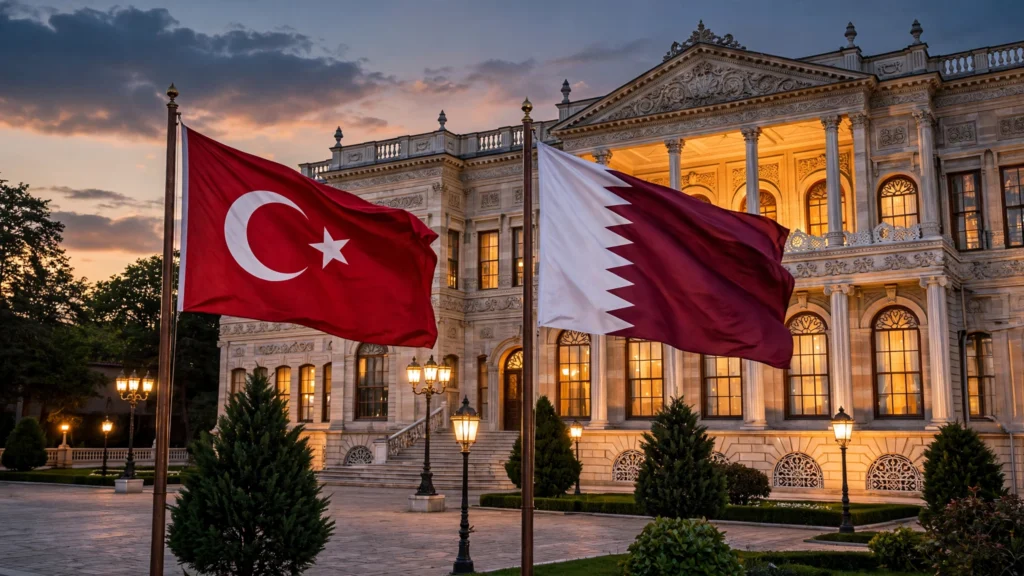
Türkiye’s mutual defence pact with Qatar does not require either country to automatically send troops if the other is attacked, Ankara clarified on Thursday — any military support would depend on an explicit request and mutual consent, under the UN Charter. The clarification, a week after the pact was signed in Istanbul on 13 November, defines a deal that analysts say is designed to deter attacks rather than build an offensive alliance.
Key Takeaways
- President Recep Tayyip Erdogan and Qatar’s Emir Sheikh Tamim bin Hamad Al Thani signed the mutual defence agreement in Istanbul on 13 November, during the 12th meeting of the Türkiye–Qatar Supreme Strategic Committee.
- On 19 November, Türkiye’s Defence Ministry said the pact “does not create an automatic obligation to send troops directly in the event of any attack” — support would be decided on an explicit request, under Article 51 of the UN Charter, and by mutual agreement.
- Political decisions on implementation will be taken by consensus in a High Strategic Council of the two countries’ foreign and defence ministers; no binding decision has been made on allocating personnel, forces or money.
- The pact aims to strengthen deterrence, protect sovereignty and territorial integrity, and deepen defence cooperation, including joint exercises, personnel exchanges and joint production.
- The agreement runs for an initial 10 years, followed by five-year extensions; Türkiye’s NATO rights and obligations are unaffected.
- The full text of the pact has not been made public, and it does not say that an attack on one country is automatically an attack on the other — unlike the Makkah joint defence agreement signed by Türkiye, Saudi Arabia and Pakistan in August.
Signed in Istanbul, clarified in Izmir
The agreement was signed at the Presidential Dolmabahce Office in Istanbul on Friday 13 November, after bilateral and delegation-level talks between Erdogan and Sheikh Tamim, as part of the 12th meeting of the Türkiye–Qatar Supreme Strategic Committee. It was the centrepiece of a package of five agreements and memoranda signed during the meeting. The signing came as the region reels from the US–Israeli war with Iran, which began on 28 February, and from a series of attacks on Gulf states — including Iranian strikes on Qatar earlier in the war and Houthi missile attacks on Saudi Arabia this week. Analysts quoted in regional coverage said the pact aims to deter attacks rather than build an offensive alliance. The clarification came on Thursday at the Defence Ministry’s weekly press briefing, held at the NATO EDGE 2026 event in Izmir, where ministry spokesman Rear Admiral Zeki Aktürk answered reporters’ questions about the scope of the agreement. “Under the agreement, support that may be provided in the event of an externally sourced armed attack against one of the parties will be determined upon the explicit request of the relevant party, within the framework of Article 51 of the United Nations Charter and by mutual consensus,” the ministry said. “In this framework, the agreement does not create an automatic obligation to directly send troops in the event of any attack.”
What the pact actually commits
According to the ministry, the agreement aims to protect the two countries’ sovereignty and territorial integrity, develop cooperation in defence, increase deterrence, and contribute to regional peace and stability. It provides for joint military exercises, personnel exchanges, interoperability, defence industry cooperation, joint production and technology development. Political decisions on implementation will be taken by consensus in a High Strategic Council made up of the two countries’ foreign and defence ministers or their authorised representatives. The ministry stressed that there is currently no binding decision under the agreement on allocating personnel, military forces or financial resources, and that cost-sharing for possible joint activities will be decided by the council. The agreement provides for an initial 10-year term from its entry into force, followed by possible five-year extensions under specified conditions. Türkiye’s existing NATO rights and obligations remain unaffected — an important point, since Qatar is not a member of NATO, and an attack on Qatari territory would not automatically activate NATO’s collective defence provisions. What the pact does not do is as important as what it does. The published text does not say that an attack on one country is automatically an attack on the other. It does not create an automatic obligation to deploy troops. It does not specify what would trigger a joint response or what form that response would take. The full text of the agreement has not been publicly released.
How it compares with the Makkah pact
The Türkiye–Qatar text is deliberately softer than the Makkah Joint Defence Agreement signed by Türkiye, Saudi Arabia and Pakistan in August 2026, which explicitly treats an attack on one party as an attack on all. The Qatar agreement commits the two countries to a unified position against external armed attacks, but leaves the details of that position to be decided in a crisis. The difference reflects the different relationships. Türkiye’s law approving the Makkah pact took effect on Saturday 14 November, one day after the Qatar agreement was signed. Syria is reported to be considering joining the Makkah arrangement. The Qatar pact, by contrast, builds on a 2014 defence cooperation accord and on Türkiye’s troop presence at the Tariq bin Ziyad base near Doha since 2015 — a long-standing bilateral military relationship that the new agreement formalises and deepens without turning it into an automatic war commitment. Pakistan, which recently signed a security pact with Qatar, is also a party to the Makkah agreement. The joint communique issued at the signing also welcomed the Badr memorandum on joint defence production, technology development and information sharing, signed by Türkiye, Qatar, Pakistan and Indonesia — a sign that the web of defence ties among these countries is being built in parallel, piece by piece, rather than in a single alliance.
Why the clarification matters now
The ministry’s clarification was not abstract. With the US–Iran war widening — Houthi missiles striking Riyadh for three consecutive days, tankers hit near the Strait of Hormuz, and Iran’s conditions for reopening the strait still unmet — the question of who would fight for whom in the Gulf is live. The Saudi coalition intercepts Houthi missiles and drones over Riyadh, and the Houthis strike Riyadh again this week. Ankara has nevertheless ruled out deploying troops against the Houthis under the pact, according to regional reporting. The clarification serves two audiences at once. For Doha, it confirms that Türkiye stands behind Qatar’s sovereignty — a meaningful commitment from the region’s largest military power, given that Qatar was itself struck during the war. For Ankara’s other partners, and for Washington, it sets a limit: the pact is a political commitment to a common position, decided case by case, not a blank cheque. That balance — deterrence without automaticity — is the point of the agreement. Whether it deters will depend on whether potential attackers believe that, when the moment comes, the explicit request will be made and the mutual consent will follow.
When did Türkiye and Qatar sign their defence pact?
President Recep Tayyip Erdogan and Qatar’s Emir Sheikh Tamim bin Hamad Al Thani signed the mutual defence agreement in Istanbul on 13 November 2026, during the 12th meeting of the Türkiye–Qatar Supreme Strategic Committee. It was the centrepiece of a package of five agreements signed at the meeting.
Does the pact require Türkiye or Qatar to send troops automatically if the other is attacked?
No. Türkiye’s Defence Ministry clarified on 19 November that the agreement “does not create an automatic obligation to send troops directly in the event of any attack”. Any support would be decided on an explicit request from the attacked party, under Article 51 of the UN Charter, and by mutual agreement in a High Strategic Council.
How is this pact different from the Makkah defence agreement?
The Makkah Joint Defence Agreement signed by Türkiye, Saudi Arabia and Pakistan in August 2026 explicitly treats an attack on one party as an attack on all. The Türkiye–Qatar text does not contain that language: it commits the two countries to a unified position against external armed attacks, but leaves the trigger and the form of any joint response to be decided in a crisis. Its full text has not been made public.
Sources:
- Daily Sabah, “Türkiye rules out automatic troop deployment under Qatar defense pact”, 19 Nov 2026 — https://www.dailysabah.com/politics/turkiye-rules-out-automatic-troop-deployment-under-qatar-defense-pact/news/amp
- Türkiye Today, “Türkiye-Qatar defense pact doesn’t mean automatic troop deployment: Defense Ministry”, 19 Nov 2026 — https://www.turkiyetoday.com/nation/turkiye-qatar-defense-pact-does-not-mean-automatic-troop-deployment-defense-ministry-3232760
- Corridor Atlas, “Turkey and Qatar sign mutual defense pact in Istanbul”, 17 Nov 2026 — https://corridoratlas.com/politics/defence/turkey-and-qatar-sign-mutual-defense-pact-in-istanbul/
- RayTech Institute, “Qatar-Turkiye Defence Pact Explained”, 15 Nov 2026 — https://raytechinstitute.com/blogs/qatar-turkiye-mutual-defence-pact-november-2026-explained/