
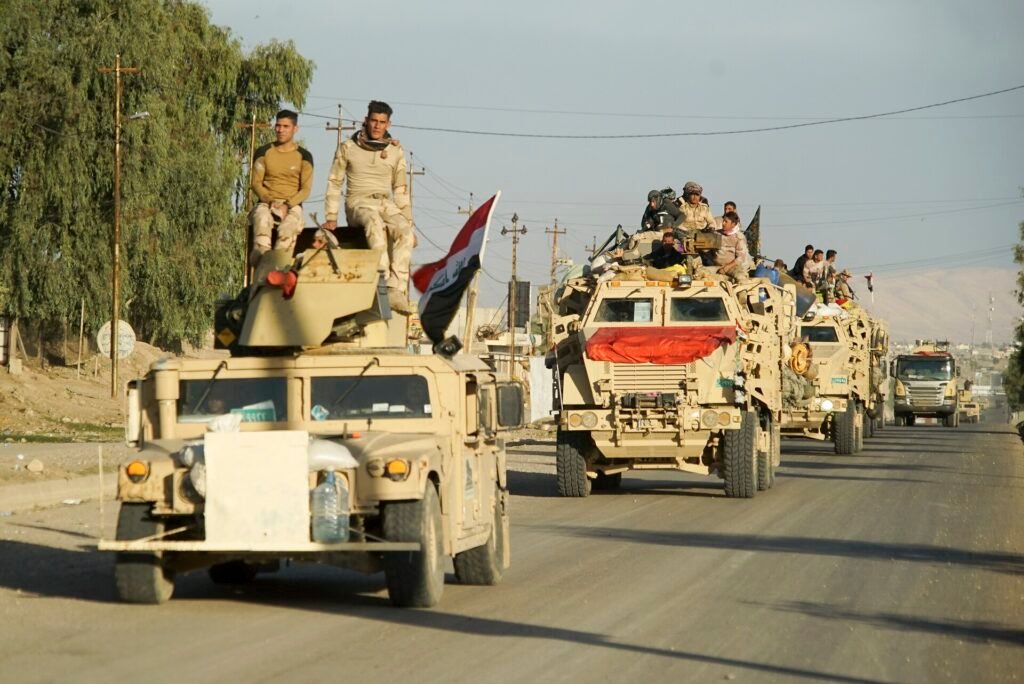
Iraqi government forces entered Jurf al-Sakhar on Friday, the main stronghold of the Iran-aligned Kataib Hezbollah militia, under a compromise deal reached late on Thursday to avert a confrontation. The deployment ends more than 12 years of exclusive militia control over the town, south of Baghdad — but the group keeps its weapons, and its fighters will withdraw only within a month.
Key Takeaways
- Iraqi security forces deployed in Jurf al-Sakhar, in Babil province about 60km southwest of Baghdad, on Friday under a deal that seeks to limit the reach of Iran’s most powerful Shia militia ally in Iraq without provoking a fight.
- The government had accused Kataib Hezbollah of stealing hundreds of millions of dollars’ worth of Iraqi oil through illicit refineries, and gave the group until Friday to leave the town.
- Under the compromise, Kataib Hezbollah is expected to withdraw from the area within a month, while an Iraqi army brigade, a Federal Police battalion, an Energy Police regiment and two Popular Mobilisation Forces brigades deploy to protect oil pipelines.
- A joint control headquarters has been established in the town, with the Federal Police in charge; the 70km road to Karbala is to reopen.
- Esmail Qaani, commander of Iran’s Revolutionary Guard Corps’ Quds Force, visited Iraq earlier in the week and helped defuse the tension and seal the deal, according to multiple sources.
- Prime Minister Ali al-Zaidi called the deployment the start of the state asserting control across Iraq: “No weapons outside state authority, no weapons but Iraq’s, no decisions but Iraq’s.”
A convoy rolls in — and no shots are fired
A convoy of vehicles flying Iraqi flags headed into Jurf al-Sakhar on Friday, and soldiers took up positions in the town centre after senior security officials told a press conference that government forces would protect the town. Members of Kataib Hezbollah stood near their group’s flags as the troops arrived. An AFP correspondent in the town reported seeing police forces pass through the first Kataib Hezbollah checkpoint, where the group’s fighters remained deployed. Iraqi media described the deployment as a success and said it went “smoothly”. No resistance was reported, and no violations were recorded during the deployment. The town, also known as Jurf al-Nasr, sits about 60km southwest of Baghdad in Babil province, on the road to the holy city of Karbala. It has been closed to outsiders for about 12 years, according to the government — since Kataib Hezbollah helped recapture the area from Islamic State and then stayed, building it into its main stronghold.
The oil-smuggling accusation
The standoff began on Monday, when the government announced it would take control of Jurf al-Sakhar after an investigation raised suspicions that Kataib Hezbollah had stolen hundreds of millions of dollars’ worth of Iraqi oil via illicit refineries in the area. Prime Minister Ali al-Zaidi ordered security forces to prepare to move against the heavily armed group and gave it a deadline of Friday to leave the town. Kataib Hezbollah, one of dozens of heavily armed pro-Iranian groups that hold semi-official status in Iraq, has denied the allegations of stealing oil. The group is believed to have thousands of trained fighters, and in recent days it had warned that anyone entering the town would do so “over our dead bodies”, raising fears the dispute could escalate into open fighting between Iraqi forces and the militia. The deal that averted that outcome was sealed late on Thursday after lengthy and delicate talks, according to Al Jazeera. Baghdad-based security analyst Fadel Abu Raghif said the agreement followed “in-depth negotiations, and after wrangling and a tug of war that lasted about two months or so”.
Qaani’s role — and the limits of the deal
The compromise was driven by pressure from the United States and its Gulf allies, Al Jazeera reported, and by the intervention of Esmail Qaani, the commander of Iran’s Islamic Revolutionary Guard Corps’ Quds Force. Qaani visited Iraq earlier in the week to help defuse the tension and seal the deal, and three Iraqi sources, including two from Tehran-backed factions, told AFP that Qaani helped defuse tensions, with two saying he secured a one-month window to resolve the issue. The terms of the deal show how far the compromise goes — and how far it does not. Kataib Hezbollah keeps its weapons, and its members will withdraw to other parts of Iraq rather than disarm. The joint command that will oversee the area includes members of Iran-aligned militias recognised as part of Iraq’s security forces, and the prime minister agreed to include Iran-aligned Popular Mobilisation Forces units in the joint command. Under the arrangement, a combined force comprising an Iraqi army brigade, a Federal Police battalion and an Energy Police regiment will protect oil pipelines in the area, and two brigades from the Popular Mobilisation Forces Commission will also participate. Lieutenant General Ahmed Hatem Hamid said on Friday that a control headquarters had been established in Jurf al-Sakhar and that the Federal Police would control the facility, according to the Iraqi News Agency. Iraq’s Energy Police have also begun securing an oil pipeline running through the town. The standoff is unfolding against a wider regional escalation, including Iran’s attacks on Kuwait and Bahrain, and the Houthis strike Riyadh again, in a strike in which a Houthi missile hit the PIF Tower in Riyadh.
“From Jurf al-Sakhar, we begin asserting state authority”
Prime Minister Zaidi presented the deployment as a turning point. “From Jurf al-Sakhar, we begin asserting state authority across all of Iraq, confronting corruption and weapons beyond state control,” he told government troops who entered the town, speaking from a military operations centre in Baghdad. “Our decision is firm: No weapons outside state authority, no weapons but Iraq’s, no decisions but Iraq’s, and no flag shall fly higher than the Iraqi flag.” The departure of Kataib Hezbollah will allow the reopening of an area that has been closed for about 12 years, Al Jazeera’s correspondent in Babil province reported, including the 70km road to Karbala. A security headquarters to oversee the handover was due to open on Saturday. The deal marks another compromise for Zaidi, who appears to recognise the limits of his authority, according to Ynet’s analysis — a prime minister who ordered a confrontation and then settled for a negotiated entry in which the militia keeps its arms and joins the joint command.
What happens next
The immediate test is whether Kataib Hezbollah actually withdraws within the month, as the deal requires, and whether the Federal Police can hold the town without the militia’s shadow. The longer test is whether Zaidi’s government can extend the same assertion of state authority to the dozens of other armed groups that operate across Iraq with semi-official status — many of them, like Kataib Hezbollah, part of the Popular Mobilisation Forces and answerable to Tehran as much as to Baghdad. For now, the government has what it wanted most: its flag flying in Jurf al-Sakhar without a battle. Whether that becomes the start of state control, as the prime minister claims, or another negotiated pause in a long standoff, will be decided by what happens over the next month.
What happened in Jurf al-Sakhar on Friday?
Iraqi government forces entered Jurf al-Sakhar, the main stronghold of the Iran-aligned Kataib Hezbollah militia, on Friday under a compromise deal reached late on Thursday. Soldiers took up positions in the town centre without resistance, ending more than 12 years of exclusive militia control over the town in Babil province, about 60km southwest of Baghdad.
Why did the Iraqi government move against Kataib Hezbollah?
The government said an investigation raised suspicions that the group had stolen hundreds of millions of dollars’ worth of Iraqi oil through illicit refineries in the area, and gave it until Friday to leave the town. Kataib Hezbollah denies the allegations. The group keeps its weapons under the deal and is expected to withdraw from the area within a month.
Who brokered the deal, and what does it involve?
The deal followed lengthy talks and was helped by Esmail Qaani, commander of Iran’s Quds Force, who visited Iraq earlier in the week. Under it, an Iraqi army brigade, a Federal Police battalion, an Energy Police regiment and two Popular Mobilisation Forces brigades deploy to protect oil pipelines, with a joint control headquarters under Federal Police command. The 70km road to Karbala is to reopen.
Sources:
- Al Jazeera, “Iraqi forces deploy to Jurf al-Sakhar after deal with Iran-backed group”, 20 Nov 2026 — https://www.aljazeera.com/news/2026/11/20/iraqi-forces-deploy-to-jurf-al-sakhar-after-deal-with-iran-backed-group?traffic_source=rss
- Associated Press (via Channel News Asia), “Iraqi forces enter stronghold of Iran-backed group under compromise deal”, 20 Nov 2026 — https://www.channelnewsasia.com/world/iraqi-forces-enter-stronghold-iran-backed-group-under-compromise-deal-6569101?cid=cna_flip_070214
- The Straits Times, “Iraqi security forces deploy in Iran-backed militia stronghold”, 20 Nov 2026 — https://www.straitstimes.com/world/middle-east/iraqi-security-forces-to-deploy-in-iran-backed-militia-stronghold-security-officials-say
- Dawn, “Iraqi forces enter pro-Iran militia’s stronghold”, 21 Nov 2026 — https://www.dawn.com/news/2046063