
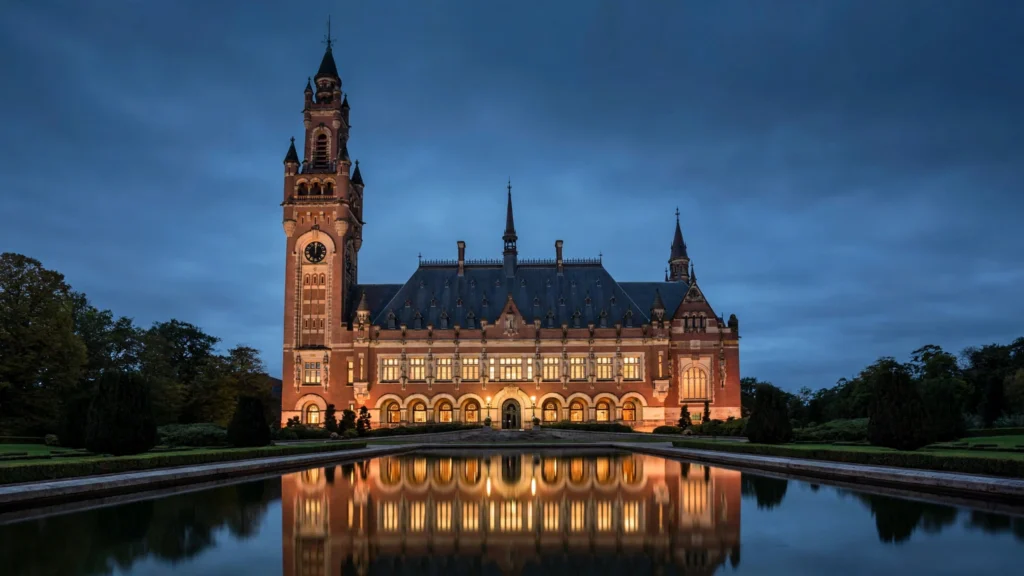
The International Court of Justice has ruled that Myanmar committed genocide against the Rohingya people, in a landmark judgment that is the first time in the court’s 80-year history that a state has been held responsible for the crime of genocide. The ruling, delivered in The Hague on Thursday 19 November, found by nine votes to six that Myanmar’s military committed genocide against the mainly Muslim Rohingya minority in northern Rakhine state in 2017, in violation of the Genocide Convention.
The judgment, read out over three hours by the court’s president, Judge Yuji Iwasawa of Japan, is only the fourth time since the Nazi Holocaust that an international court has found that genocide was committed. It comes after a case brought by The Gambia in November 2019, and after years of testimony from survivors, evidence from international investigators and graphic accounts of the military’s clearance operations.
The court found that Myanmar’s security forces killed at least 10,000 Rohingya people, perpetrated widespread sexual violence and acts of extreme violence against children, and attacked fleeing civilians — driving more than 730,000 Rohingya across the border into Bangladesh. It ordered Myanmar to cease violations, investigate and prosecute those responsible, and provide restitution and reparations, including the safe, voluntary and dignified return of the displaced.
Key Takeaways
- The International Court of Justice ruled 9–6 on 19 November that Myanmar committed genocide against the Rohingya in northern Rakhine state in 2017, violating the Genocide Convention.
- It is the first time in the ICJ’s 80-year history that a state has been found responsible for genocide, and only the fourth such finding by an international court since the Nazi Holocaust.
- Evidence showed at least 10,000 Rohingya were killed and more than 730,000 were driven to flee to Bangladesh; nearly 400 villages were partially or totally destroyed.
- The court ordered Myanmar to cease violations, investigate and prosecute those responsible, guarantee non-repetition, and provide restitution and compensation, including safe, voluntary and dignified return.
- The ruling is final and cannot be appealed, but the ICJ has no enforcement power of its own — compliance depends on Myanmar and on pressure from the UN Security Council and other states.
- The case was brought by The Gambia in November 2019; the United Kingdom said it would expel Myanmar’s defence attache and called for an urgent UN Security Council session.
A three-hour verdict
The judgment was delivered at the end of a three-hour ruling at the Peace Palace in The Hague. Judge Iwasawa detailed how Myanmar’s military had perpetrated “extreme violence” against Rohingya communities in Rakhine state, and declared that Myanmar had also failed to prevent and punish genocide.
“The Court finds that Myanmar’s security forces killed thousands of Rohingya civilians, perpetrated widespread acts of sexual violence, as well as acts of extreme violence against children, and attacked fleeing Rohingya as they sought to flee in large numbers to Bangladesh,” the judge said.
The ruling establishes that Myanmar’s security forces “and other State organs” intentionally committed specifically prohibited acts covered by Article II of the Genocide Convention: killing members of the group, causing serious bodily or mental harm, and imposing measures intended to prevent births within the group. The court heard that the murder of infants during the clearance operations “supports the inference that Myanmar’s security forces acted with the intent to prevent births among the group.”
The hardest part of any genocide case is proving specific intent — the intent to destroy a group in whole or in part — and it is an extremely high bar. “The ICJ had never before ruled that a state has specific intent to commit genocide,” international human rights lawyer Toby Cadman told Al Jazeera. “The court is guided by the genocide convention and what the genocide convention states, and it is a high threshold.”
What the evidence showed
The court based its ruling on graphic evidence and testimonies from survivors and reports from international investigators, describing how Rohingya villages and bridges were set alight and bulldozed, with men and boys executed and girls and women raped during military clearance operations in northern Rakhine in 2017.
The court heard testimonies from three witnesses from the Rakhine state villages of Min Gyi, Chut Pyin and Maung Nu. Nearly 400 villages — approximately 40 per cent of the almost 1,000 villages in the three townships of northern Rakhine state — were partially or totally destroyed during and after the 2017 clearance operations. “Bulldozing and large-scale terrain clearance often followed the destruction… in turn, rapid construction took place on the cleared sites, including security installations, new villages and houses, and other civilian infrastructure,” Judge Iwasawa explained.
Myanmar claimed its crackdown was in response to attacks on police posts by fighters from the Arakan Rohingya Salvation Army (ARSA). The court also heard evidence from a witness called by Myanmar about an attack in which ARSA fighters allegedly killed around 100 civilians. But the court concluded that the “only reasonable inference” from the evidence of widespread atrocities by Myanmar’s security forces was that they had the intent to destroy a “substantial part” of the Rohingya minority. It also found that Myanmar should have known there was a risk of genocide when armed civilians participated in the military campaign, and therefore violated its obligation to prevent genocide.
What the court ordered
As a consequence of the breaches, the court ordered Myanmar to cease any ongoing violations by enacting legislation giving full effect to its obligations under the Genocide Convention, and to take immediate and effective steps to investigate all persons reasonably suspected of having committed acts contrary to the Convention and, if warranted, to prosecute and punish them.
Myanmar must also provide assurances and guarantees of non-repetition, adopt measures of restitution in the interest of the Rohingya — including allowing their safe, voluntary and dignified return to their places of residence and the reunification of families — and compensate the Rohingya group and its members for the damage caused. Appropriate restitution, the court said, would include returning or replacing damaged collective property, facilitating the search for the disappeared and ensuring proper burials, providing physical and psychological rehabilitation, and ensuring the population’s protection from persecution.
The court decided that the question of the amount and modalities of compensation should be determined in a subsequent phase of the proceedings, and that Myanmar should transmit to it, within two years, a report on the measures of restitution it has adopted and the amount and modalities of compensation. The judgment is final, binding on the parties and without appeal.
Reactions: “Justice has been decided, but not yet delivered”
UN Secretary-General António Guterres welcomed the judgment as a “powerful recognition of the Rohingya victims of genocide. It is a demonstration of international justice and a reaffirmation that impunity for such horrific acts must not stand.” He stressed that ending impunity in Myanmar and ensuring accountability remained essential to national reconciliation.
The Gambia, which brought the case, called the ruling “a historic day for international justice” and urged Myanmar to comply “fully and without delay”. The Special Advisory Council for Myanmar welcomed the judgment but stressed that the decision must lead to concrete accountability measures and reparations. Founding member Yanghee Lee said it was a “deeply emotional day for all Rohingya people”, adding that “justice has been decided, but not yet delivered”.
“For decades, the Burmese military tried to erase our identity, deny our existence, and dismiss our suffering,” said Wai Wai Nu, executive director of the Women’s Peace Network and a former political prisoner. “By finding that Myanmar committed genocide, ordering a guarantee of non-repetition, and ordering restitution and compensation, the world’s highest court has permanently shattered that state-sponsored lie.”
British Foreign Secretary Ed Miliband said the United Kingdom would expel Myanmar’s defence attache and called for an urgent UN Security Council session to discuss the judgment. Amnesty International said: “We hope this ruling marks the beginning of a long overdue process of accountability in Myanmar,” adding that all crimes under international law “must be effectively investigated and those suspected of responsibility brought to justice”.
Why enforcement is the hard part
The ruling is historic, but the court has no police force and no direct means of enforcing its orders. Whether the judgment changes anything on the ground will depend on what happens next — including whether the issue goes before the UN Security Council, whether sanctions or other remedies follow, and whether Myanmar’s military government, which has ignored previous provisional orders from the court, complies this time.
That context matters because the human cost continues. More than 1.3 million Rohingya remain displaced across South and Southeast Asia, including 1.2 million in sprawling refugee camps in Cox’s Bazar in Bangladesh, according to the UN. Conflict, shrinking humanitarian aid and dangerous sea crossings continue to leave members of the community displaced and vulnerable.
For the Rohingya themselves, the verdict is both a vindication and a beginning. Reporting from The Hague, Al Jazeera’s Step Vaessen said the verdict is “extremely important for the Rohingya”. “They’ve been waiting for 10 years for any kind of justice, but it’s also important for the whole international community because genocide is such a difficult act to prove.”
The court’s ruling does not end the story. It establishes, as a matter of international law, that a genocide took place — and it puts the world on notice that the obligation to act on that finding now belongs to states, to the United Nations, and to the institutions that must decide what accountability looks like when a court has spoken and a government has not yet listened.
Frequently Asked Questions
What did the International Court of Justice decide about Myanmar and the Rohingya?
On 19 November 2026, the ICJ ruled by 9 votes to 6 that Myanmar committed genocide against the Rohingya in northern Rakhine state in 2017, violating the Genocide Convention. It is the first time the court has held a state responsible for genocide in its 80-year history.
What evidence did the court rely on?
The court cited evidence that at least 10,000 Rohingya were killed, more than 730,000 fled to Bangladesh, and nearly 400 villages were destroyed, along with survivor testimony describing killings, sexual violence and the murder of infants. It found the only reasonable inference was that Myanmar’s forces acted with genocidal intent.
Can the ruling be appealed, and who enforces it?
The judgment is final, binding on the parties and without appeal. But the ICJ has no enforcement power of its own, so compliance depends on Myanmar and on pressure from the UN Security Council and other states. The court will decide the amount and modalities of compensation in a later phase, and Myanmar must report on restitution within two years.
Related coverage
Sources
- UN News — World’s top court finds Myanmar guilty of genocide against Rohingya
- Al Jazeera — UN’s top court finds Myanmar guilty of genocide against Rohingya
- CNN — In historic first, UN top court rules a country committed genocide
- Reuters — Reactions as top UN court finds Myanmar guilty of genocide against Rohingya