
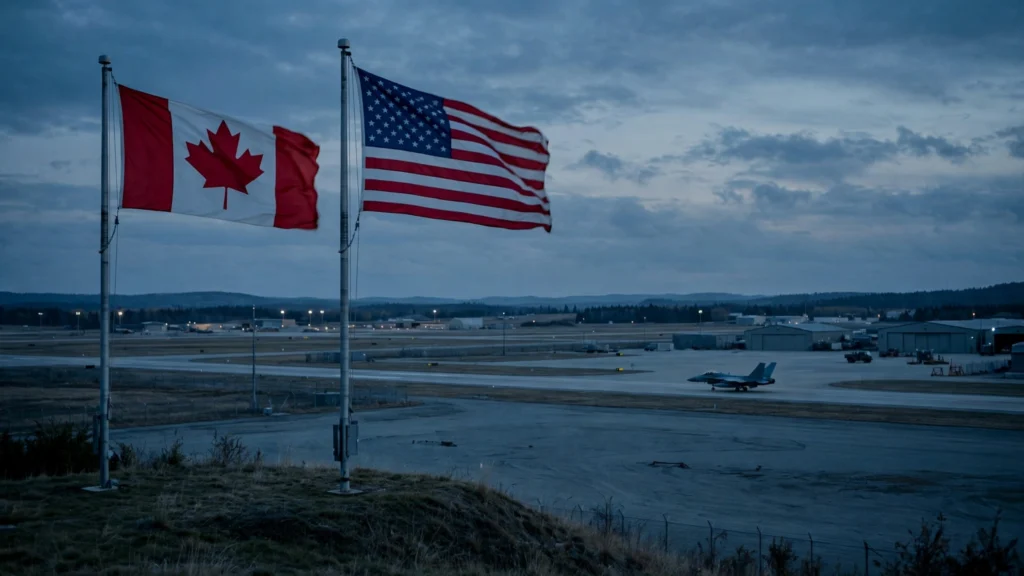
The United States has imposed new restrictions on its defence relationship with Canada in a classified memo from Defence Secretary Pete Hegseth, the Washington Post reported on Friday, in the latest sign of strain between the two longtime allies. The same day, President Donald Trump said at the White House that Canada had been “ripping us off for many, many years” and had not agreed to a trade deal on terms the United States wants.
Key Takeaways
- Defence Secretary Pete Hegseth imposed new restrictions on US–Canada defence cooperation in a classified memo distributed last week, the Washington Post reported on Friday, citing officials familiar with the directive.
- A US official described the move as a “slap in the face” to Canadians, according to the Post.
- The Pentagon said the guidelines would not affect bilateral defence intelligence sharing or military cooperation through NATO and NORAD.
- A Five Eyes official told the Post that the amount of intelligence the United States shares with allies through various channels has decreased over the past year.
- Trump told reporters on Friday that Canada had been “very difficult for this country for 50 years” and put the US trade deficit with Canada at “about $80 billion” — official US figures put the 2025 goods deficit at $48 billion.
- The two countries share a border of about 8,892 kilometres and are both founding members of NATO, with close military and security ties built up over decades.
The memo: what is known — and what is not
Hegseth imposed the new restrictions through a classified memo distributed last week, the Washington Post reported on Friday, citing US officials familiar with the matter. The specific contents of the memo could not be confirmed, the officials said, but the move could be seen as a significant affront to Canada. One US official went further, calling the directive a “slap in the face” to Canadians, in the Post’s account. The report, by the Post’s national security correspondent Dan Lamothe, described the memo as another provocation in the Trump administration’s feud with Ottawa, escalating a multifaceted clash highlighted by Trump’s repeated threat of annexation. Pentagon spokesman Sean Parnell told the Post that the Defence Department was “taking steps to ensure that cooperation with Canada advances America’s real defense objectives and ultimately supports the revitalization of the defense relationship between our two countries”. He said the new guidelines would not affect defence intelligence sharing between the two countries or military cooperation through NATO and the North American Aerospace Defense Command (NORAD), the joint US–Canadian air defence command. Even so, claims have emerged that the volume of intelligence the United States shares with its allies has in practice declined. An official from the Five Eyes intelligence-sharing alliance — which includes the United States, Canada, the United Kingdom, Australia and New Zealand — told the Post that the amount of information the US has provided to allies through various channels has decreased over the past year.
A partnership built over decades
The United States and Canada share a border stretching roughly 8,892 kilometres and are both founding members of NATO, having maintained close military and security ties for decades. Canada is a founding member of the Five Eyes alliance, and the two countries jointly operate NORAD, which has guarded North American airspace since 1958. Relations between the two countries have grown increasingly strained over trade and security issues since Trump began his second term in January last year. Trump has criticised Canada since his first term for relying too heavily on the United States for its own security, and has repeatedly suggested that Canada should become the 51st US state. The strain is paradoxical on its own terms. The US administration has pressed Canada to build a stronger military to support North American defence, while the reported memo restricts the cooperation through which that defence is organised. The Pentagon’s insistence that NORAD and intelligence sharing are untouched suggests the restrictions fall on other areas of the relationship — but because the memo is classified, its precise scope remains unverified.
Trump’s Friday remarks: “ripping us off for many, many years”
Trump publicly voiced his frustration at the White House on Friday, after returning from his trip to Asia, saying Canada had not agreed to a trade deal on terms the United States wants. “Canada has been ripping us off for many, many years, and it’s time to stop,” Trump said. “Canada has been very difficult for this country for 50 years,” he told reporters. “For some reason they’ve gotten confident,” he added. “We can’t let them feel that way anymore.” Trump claimed that the US trade deficit with Canada stood at approximately $80 billion. Official US figures put the goods trade deficit with Canada at $48 billion in 2025, according to the Office of the US Trade Representative, with a US services surplus of $27.7 billion the same year — putting the combined goods-and-services deficit near $20.6 billion. Through the first nine months of 2026, the Census Bureau’s goods deficit stands at $38.7 billion. Secretary of State Marco Rubio, who appeared alongside Trump and Vice President JD Vance, also criticised what he described as an “unfairness and imbalance” in trade relations between the two countries, and said Trump’s meeting with Carney had “moved the ball forward on getting to a final agreement that is good for American workers and fair to the United States of America”. Trump also raised the possibility of a new energy infrastructure project, claiming Carney wanted to build a Keystone pipeline for the United States. “One of the things he wants to do is build a Keystone pipeline for us. And we like that. But, you know, got to do a lot more than that,” Trump said. As of Friday evening, Carney had not issued a public statement responding to the Keystone remark.
The trade backdrop
The defence restrictions land on top of a trade dispute that has already dominated the relationship for months. Trade tensions escalated in earnest after Trump imposed tariffs on Canadian steel, aluminium and other goods following the start of his second term, prompting Canada to retaliate with its own tariffs. Trade minister Dominic LeBlanc told an advisory committee on Thursday that Ottawa still seeks an interim arrangement to ease some US tariffs, but Washington has shown little movement. US tariffs on Canadian steel, autos and lumber are set to rise in January to 50 per cent from 25 per cent, and industry groups have warned the increase could dismantle decades-old supply chains and cost jobs. The pressure on Canada’s auto industry intensified this month. Stellantis announced on 9 November that it had agreed to sell its assembly plant in Brampton, Ontario, to armoured vehicle manufacturer Roshel, after abandoning plans to manufacture the Jeep Compass there. More than 2,200 workers have been laid off since production stopped in December 2023. Ottawa has accused Stellantis of failing to honour commitments made when it received public funding; Canadian Industry Minister Melanie Joly has threatened legal action and offered the company an additional support package to keep the facility operational. On Friday, Joly also announced C$465 million in support for Ford’s operations in Oakville, Ontario. LeBlanc told CBC on Thursday that an interim deal would likely still include some level of Section 232 tariffs on steel, aluminium, autos and lumber, though at lower rates. Canada’s chief trade negotiator, Janice Charette, told a House of Commons committee this week that the aim is “the lowest rate of tariff on the narrowest basket of goods”, The Canadian Press reported.
What happens next
Carney met Trump for about 20 minutes on the sidelines of the APEC summit in Shenzhen on 18 November, with no trade breakthrough, and the two leaders agreed to continue the work and stay in close contact. Carney has said Canada will not accept an agreement that undermines its economic interests, and will continue diversifying its trade relationships if the US is unwilling to make a deal. The immediate questions are whether the contents of Hegseth’s memo become public — or are confirmed by the Pentagon — and whether Ottawa responds formally. Canada’s government had not publicly commented on the memo as of Friday evening. What is clear is that the dispute has now spread from tariffs into the defence relationship itself, the part of the partnership both countries have long treated as beyond politics.
What did Pete Hegseth’s memo reportedly do?
According to the Washington Post, Defence Secretary Pete Hegseth imposed new restrictions on US–Canada defence cooperation in a classified memo distributed last week. The specific contents could not be confirmed, but US officials familiar with the directive described it as a significant affront to Canada.
Does the memo affect NORAD or intelligence sharing?
No, according to the Pentagon. Spokesman Sean Parnell said the new guidelines would not affect bilateral defence intelligence sharing or military cooperation through NATO and NORAD, though a Five Eyes official told the Post that the amount of intelligence the US shares with allies has decreased over the past year.
What did Trump say about Canada on Friday?
Trump said Canada had been “ripping us off for many, many years” and had been “very difficult for this country for 50 years”, and claimed the US trade deficit with Canada was about $80 billion. Official US figures put the 2025 goods deficit at $48 billion, with a $27.7 billion US services surplus the same year.
Sources:
- Reuters, “US Defense Secretary Hegseth restricts military ties with Canada, Washington Post reports“, 20 Nov 2026
- The Herald Business (Washington Post report), “US restricts defense cooperation with Canada amid deepening tensions“, 21 Nov 2026
- Times Now, “Trump Blasts Canada, Says US Has Been ‘Ripped Off’ For 50 Years Over Trade“, 21 Nov 2026
- Newsmax, “Trump: US Working Toward Fair Trade Deal With Canada“, 20 Nov 2026