
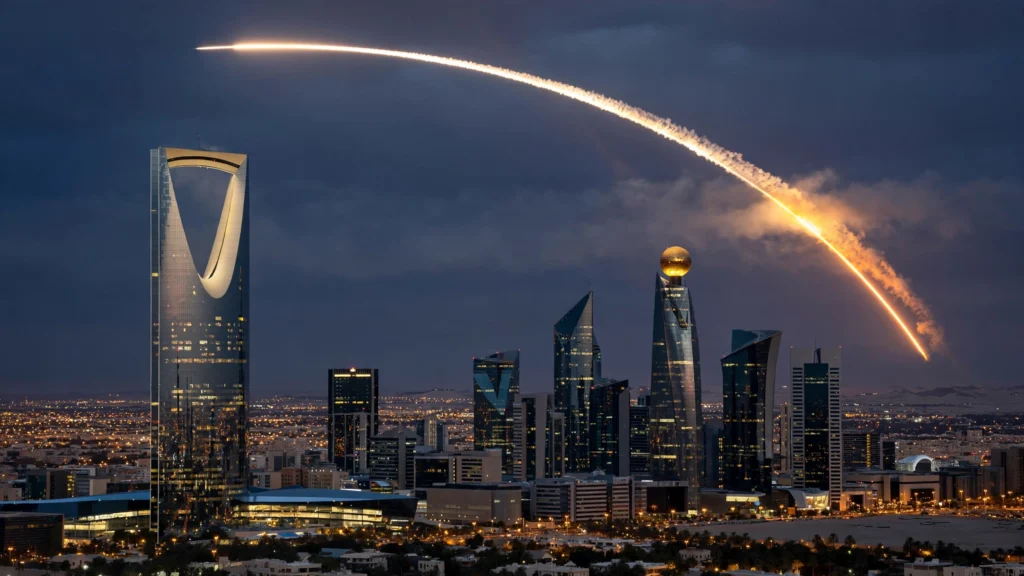
Saudi Arabia intercepted five drones and a ballistic missile fired by Yemen’s Houthis on Friday morning, with Riyadh among the targets, the Saudi-led coalition said — a day after a Houthi missile damaged the capital’s tallest tower. The coalition also struck Houthi weapons-smuggling targets in the port of Hodeidah and carried out an operation in the rebel-held capital Sanaa, as President Donald Trump said Iran wants a deal with the United States, but not one “acceptable” to him.
Key Takeaways
- The Saudi-led coalition said on Friday it intercepted five drones and one ballistic missile fired by the Houthis on Friday morning; Riyadh was among the targets.
- The coalition struck targets used by the rebels to smuggle and transport weapons and ballistic missiles in Yemen’s main Red Sea port of Hodeidah, and carried out a military operation in Sanaa early Friday.
- Houthi spokesman Yahya Saree claimed attacks on Jazan port and a power station in the Al-Shuqaiq area; the coalition acknowledged debris fell in Al-Shuqaiq but reported no damage.
- Trump told reporters on Friday that Tehran wants a deal but not one “acceptable” to him: “We want to make a real deal, not a fake deal.”
- The exchanges came a day after a suspected Houthi missile struck the 80-storey PIF Tower in Riyadh’s King Abdullah Financial District, blowing out windows across seven to eight floors.
- Also on Friday, Israeli strikes killed six people in central Gaza, according to health officials, and Iraqi forces entered the Kataib Hezbollah stronghold of Jurf al-Sakhar under a compromise deal.
Friday morning: interceptions over Riyadh and the south
The Saudi-led coalition fighting Yemen’s Houthis said Friday it targeted the rebels’ operations to smuggle and transport weapons and ballistic missiles in Yemen’s main Red Sea port of Hodeidah. It added that it had carried out a military operation in Yemen’s rebel-held capital of Sanaa early Friday, targeting the Houthis’ military capabilities to prevent attacks on civilians in Yemen and Saudi Arabia. The coalition also said the kingdom intercepted five drones and one ballistic missile fired by the rebels Friday morning. Riyadh, the kingdom’s capital and largest city, was among the targets. A Houthi military spokesperson, Yahya Saree, claimed in a statement that the rebels attacked Jazan’s port in Saudi Arabia and a power station in the Al-Shuqaiq area in Jazan. The Saudi-led coalition had earlier acknowledged that debris from intercepted missiles fell in the Al-Shuqaiq area, but did not immediately report any damage. The interceptions came a day after the Iran-backed rebels said they had targeted Saudi airports, air bases and Riyadh’s financial centre. On Thursday, a suspected Houthi missile struck the 80-storey, 385-metre PIF Tower in Riyadh’s King Abdullah Financial District, blowing out windows across seven to eight floors and bending its metal facade. No injuries were reported, and the district was closed to visitors while evacuations were under way. It was the second KAFD landmark hit in under two weeks, after an Aramco tower was damaged on 8 November.
Trump: Iran wants a deal — “not a fake deal”
As rumours swirl about a return to a full-scale war with Iran, US President Donald Trump told reporters Friday that Tehran wants a deal but not one that is “acceptable” to him. “We want to make a real deal, not a fake deal,” he said at a press conference. Trump has oscillated between wanting a resolution to the longstanding nuclear issue and saying that the US does not need to make any deal with its longtime adversary. Earlier this week, he said he would end the conflict “one way or the other” and wants a “lasting” deal with Tehran. Earlier this week, Iran widened its attacks on its Gulf neighbours, targeting a US air base in Kuwait and launching several attacks on Bahrain in what appeared to be retaliation for an American strike the day before. Iran’s military said its drones targeted Patriot air defence systems and drone and missile launch platforms at Ali Al-Salem Air Base in Kuwait; Kuwait’s army said its air defences intercepted the drone attacks, and Bahrain’s military said it intercepted a number of Iranian attacks. The Saudi-led coalition said it intercepted a Houthi cruise missile fired towards southern Saudi Arabia on Thursday, hours after a tanker was struck by an unknown projectile near Khasab, Oman, in the latest attack on shipping in the Strait of Hormuz.
The wider picture: energy, shipping and the cost of the war
The International Energy Agency has called the crisis the largest threat to energy security ever, and Qatar has warned that a closure of the Strait of Hormuz has become an international crisis affecting energy security, supply chains and global economic stability. Substantial amounts of oil continue to flow to the global economy from Middle East producers despite the recent increase in Iranian attacks on shipping, energy analysts say. Around 80 per cent of the prewar amount of oil is being exported, most of it through the Strait of Hormuz under the protection of US forces. Oil also moves through pipelines leading to ports on the Red Sea and the Gulf of Oman that tankers can reach without making the dangerous run through the strait. Oil flows in the first two weeks of November fell by around 20 per cent to around 13 million barrels per day compared with October, when exports roughly equalled the prewar amounts of 15–16 million barrels per day, according to Rystad Energy. Reasons for the November decline include Iranian attacks that discourage tankers from attempting the strait crossing, and reduced flows through a key Saudi pipeline to the Red Sea port of Yanbu that has been attacked several times. Shipping through the Strait of Hormuz remains about 65 per cent below pre-war levels, according to the United Kingdom Maritime Trade Operations. The Pentagon has said the war against Iran has cost the US military more than $48 billion since the United States and Israel launched the conflict in late February.
Gaza and Iraq: Friday’s other developments
In Gaza, Israeli strikes killed six people in central Gaza on Friday, according to health officials at Gaza’s Awda hospital and Al-Aqsa Martyrs hospital, where the casualties were taken. An overnight strike killed one person in the Nuseirat refugee camp, while a second strike killed another person in the city of Deir al-Balah on Friday afternoon. A third strike killed four people in the Bureij refugee camp on Friday evening. Israel’s military confirmed attacking “militants” in a few strikes in central Gaza, without elaborating. In Iraq, army troops and police deployed on Friday to a city south of the capital to assert control in a longtime stronghold of a powerful Iran-backed militia. Iraqi security forces set up a command headquarters on the outskirts of the Jurf al-Sakhar area south of Baghdad, aiming to assert control over the stronghold of Kataib Hezbollah, after the government called for the militia to withdraw amid allegations that it was using the area for oil smuggling.
What happens next
The pattern of the past week is now familiar: Houthi attacks on Saudi Arabia and shipping, Saudi-led coalition strikes on Houthi targets in Yemen, and a war of words over whether — and on what terms — the wider US–Iran conflict ends. Trump has said he will “see what happens” on Iran after 1 January, and has not ruled out fresh strikes. Saudi Arabia, for its part, has warned it will not tolerate attacks on its territory or national assets, and has urged the UN Security Council’s permanent members to condemn the attacks. With shipping through the Strait of Hormuz still running far below pre-war levels and oil exports down a fifth from October, the economic pressure is building on all sides — even as the diplomatic path remains unclear.
What did Saudi Arabia intercept on Friday?
The Saudi-led coalition said the kingdom intercepted five drones and one ballistic missile fired by the Houthis on Friday morning, with Riyadh among the targets. The coalition also struck Houthi weapons-smuggling targets in Hodeidah port and carried out an operation in Sanaa.
What did Trump say about a deal with Iran?
Trump told reporters on Friday that Tehran wants a deal but not one “acceptable” to him, adding: “We want to make a real deal, not a fake deal.” He has also said he intends to end the conflict “one way or the other” and wants a “lasting” deal.
How is the war affecting oil and shipping?
Around 80 per cent of pre-war oil volumes are still being exported, mostly through the Strait of Hormuz under US protection, but flows in the first two weeks of November fell about 20 per cent to around 13 million barrels a day, and shipping through the strait is about 65 per cent below pre-war levels.
Sources:
- Associated Press (via Bastille Post), “Trump says Iran wants a deal, Saudi Arabia and Yemen’s Houthis exchange fire and other Mideast news“, 21 Nov 2026
- Al Jazeera live blog, “Iran war live: Saudi-led coalition downs Houthi missiles“, 21 Nov 2026
- Gulf News live, “Middle East war: Riyadh skyscraper damaged, tanker hit near Oman as Trump weighs fresh Iran strikes“, 20 Nov 2026
Pingback: Türkiye–Qatar Defence Pact: No Automatic Troop Duty