
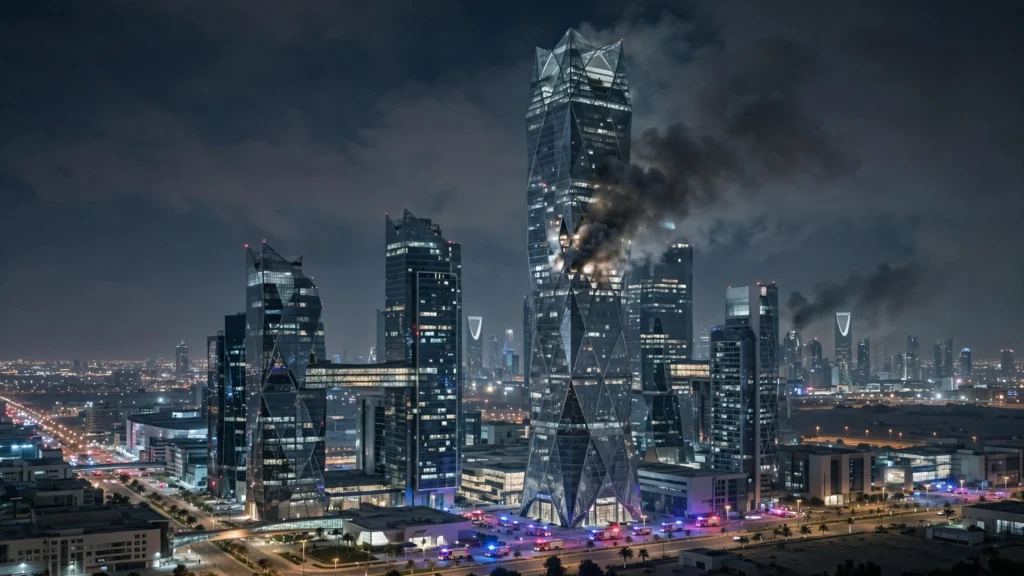
A suspected Houthi missile struck Riyadh’s tallest skyscraper on Thursday, blowing out windows across seven to eight floors of the Public Investment Fund Tower in the capital’s King Abdullah Financial District and damaging nearby buildings. No injuries were reported. Saudi Arabia warned it would not tolerate attacks on its territory or national assets, as the Iran-backed Yemeni group’s campaign against the kingdom’s economic heartland escalated sharply.
Key Takeaways
- A suspected Houthi missile hit the 80-storey, 385-metre PIF Tower in Riyadh’s King Abdullah Financial District early on Thursday 19 November, blowing out windows across seven to eight floors and bending parts of its metal facade.
- Saudi Civil Defence said the attack caused material damage to the tower and nearby buildings, but no injuries were reported; the financial district was closed to visitors and people were evacuated.
- It is the second time in under two weeks that a Houthi attack has damaged a landmark in the financial district, after the Aramco tower was hit on 8 November.
- The Saudi-led coalition said it dealt with a missile threat toward Riyadh, intercepted ballistic missiles launched toward the southern region, and destroyed a launchpad used in the attempted attacks.
- The Houthis claimed the attack hours later, saying it caused significant damage; their spokesman said the group had targeted Riyadh’s international airport and the financial district with cruise missiles.
- The strike comes as the wider regional war deepens: the International Energy Agency calls the crisis the largest threat to energy security ever, Qatar warns a Hormuz closure is a global crisis, and the Pentagon says the war against Iran has cost the US military more than $48 billion.
The strike on the PIF Tower
A skyscraper in Riyadh housing the headquarters of Saudi Arabia’s sovereign wealth fund was damaged on Thursday, witnesses told AFP, as the kingdom reported new attacks by Yemen’s Houthis. In the early hours of Thursday, AFP journalists in the Saudi capital reported a powerful blast. Around the same time, civil defence authorities issued a warning for “potential danger” but said minutes later that the danger had passed. Witnesses later told AFP that Riyadh’s Public Investment Fund Tower, which at 80 storeys is the tallest in the city’s financial district, had been damaged. “The facade is damaged across several floors, with windows blown out,” one witness said. The strike blew out windows across seven to eight floors of the PIF Tower, bending parts of its metal facade, according to the Straits Times. Images distributed by state media identified the building as the PIF Tower, the headquarters of Saudi Arabia’s sovereign wealth fund and Riyadh’s tallest skyscraper.
Saudi Arabia’s civil defence said a Houthi attack on a tower in Riyadh’s financial centre caused material damage to several floors of the building and nearby buildings, but no injuries were reported, state news agency SPA said. The statement did not identify the tower, but an accompanying photograph published by SPA showed the PIF Tower. Three sources familiar with the matter said the building had been struck by an incoming Houthi missile, Reuters reported. The Saudi-led coalition fighting the Houthis said it had “dealt with a missile threat” launched by the Houthis towards Riyadh, and that its initial assessment showed debris had fallen and material damage had been reported. The coalition’s spokesman, Major-General Turki al-Maliki, acknowledged a “missile threat” from the Houthis targeted Riyadh, and said damage had been caused from debris, without elaborating.
Entrances to the King Abdullah Financial District were closed and people were being evacuated, while ambulances and fire trucks were on the scene. There were no immediate reports of casualties.
The Houthis claim the attack
The Houthis claimed the attack hours later, saying it caused significant damage. The military spokesman for the Houthis, Yahya Saree, said in a post on X that the group had targeted Riyadh’s international airport and the financial district with cruise missiles. The Houthis said they had targeted Riyadh’s financial centre twice on Thursday, first at dawn and again in the evening.
Saudi Arabia’s Foreign Ministry condemned Houthi attacks on civilian sites, including the tower. Saudi Arabia warned on Thursday that it would not tolerate attacks on its territory or national assets, after the strikes targeted civilian and economic facilities in Riyadh.
A second landmark hit in under two weeks
The strike was the second time in less than two weeks that a Houthi attack damaged a landmark in Riyadh’s financial district. On 8 November, the Houthis said they hit the Aramco building in Riyadh’s financial district, causing visible damage to several floors, though Saudi authorities said the damage followed an interception. The Iran-backed Houthis have stepped up their attacks against Saudi Arabia in recent weeks, striking targets including airports, energy infrastructure, military sites and Riyadh’s financial district.
On Wednesday, another powerful explosion rattled homes in Riyadh, with residents saying no mobile phone alerts were issued beforehand, as is usually the case. The coalition said it had intercepted two drones launched by the Houthis in the Riyadh and southern regions. The Saudi-led coalition said on Thursday it had also intercepted ballistic missiles launched towards Saudi Arabia’s southern region, which borders Yemen, and destroyed a ballistic missile launchpad used in the attempted attacks on Riyadh.
Saudi civil defence issued several warnings of potential danger in Riyadh throughout Thursday, including after the attack, before announcing that the threat had passed. At least seven emergency warnings were issued in various parts of the country on Thursday. The Houthi-run Saba news agency reported that Saudi aircraft had carried out airstrikes on the Houthi-controlled Yemeni capital Sanaa early on Thursday, without providing further details.
Why the PIF Tower matters
Standing 385 metres high, the PIF Tower dominates the King Abdullah Financial District, which acts as a showcase for Saudi Arabia’s economic ambitions. With imposing skyscrapers, luxury shops and green spaces, the district also hosts the headquarters of the Saudi stock exchange along with multinationals such as Goldman Sachs.
The tower is home to the Public Investment Fund, chaired by Saudi Arabia’s de facto ruler Crown Prince Mohammed bin Salman. The fund is one of the largest sovereign wealth funds in the world, with more than $900 billion in assets under management, and is the key institution financing the crown prince’s plans to diversify the Saudi economy and attract international investment. Striking it is a deliberate message: the Houthis are no longer only targeting border areas and military sites, but the symbols of Saudi Arabia’s economic transformation itself.
The wider war — and the cost so far
The Riyadh strike is the latest escalation in a regional war that began on 28 February 2026, when the United States and Israel launched strikes on Iran. Since then, Iran and its allies have widened their attacks across the Gulf: Iran has fired drones at a US airbase in Kuwait and attacked Bahrain repeatedly — and shipping in the Strait of Hormuz has come under near-daily fire, including the mine attacks on tankers.
The International Energy Agency has described the crisis as the largest threat to energy security ever. Qatar warned on Thursday that the closure of the Strait of Hormuz has become an international crisis affecting energy security, supply chains and global economic stability. The Joint Maritime Information Center recorded four attacks on tankers in the strait during its latest 96-hour reporting period, compared with none in the preceding period.
The war against Iran has cost the US military more than $48 billion since the United States and Israel launched the conflict in late February, a Pentagon official said on Thursday. US President Donald Trump has said he wants a “lasting” deal with Tehran and that the conflict will end “one way or the other”, while reports say a joint US-Israeli attack on Iran remains on his table. The United Arab Emirates has strongly condemned the Houthi attacks on Saudi Arabia.
What happens next
Saudi Arabia’s warning that attacks on its territory “will not be tolerated” signals that Riyadh may escalate its response, after weeks in which the Houthis have steadily widened the range and ambition of their strikes — from border areas and airports to the financial district’s two most prominent towers. The coalition has already answered with airstrikes on Sanaa.
Whether the warning is followed by a sustained Saudi military response, or by renewed diplomacy, will shape the next phase of a war that has already disrupted global energy markets, shipping through the world’s most important oil chokepoint, and the daily life of millions of people across the Gulf.
What was hit in Riyadh on Thursday?
A suspected Houthi missile struck the Public Investment Fund Tower in Riyadh’s King Abdullah Financial District — the 80-storey, 385-metre headquarters of Saudi Arabia’s sovereign wealth fund — blowing out windows across seven to eight floors. No injuries were reported.
Has this happened before?
Yes. It is the second time in under two weeks that a Houthi attack has damaged a landmark in Riyadh’s financial district — the Aramco tower was hit on 8 November — and the Houthis have stepped up attacks on Saudi airports, energy infrastructure and military sites in recent weeks.
How has Saudi Arabia responded?
The Saudi-led coalition said it dealt with a missile threat toward Riyadh, intercepted ballistic missiles launched toward the southern region, and destroyed a launchpad used in the attempted attacks. Saudi Arabia warned it would not tolerate attacks on its territory or national assets, and Saudi aircraft carried out airstrikes on Sanaa early on Thursday.
Sources:
- The Wall Street Journal, “Houthi Attack Damages Saudi Capital’s Tallest Tower“, 20 Nov 2026
- Al Jazeera, “Saudi Arabia says Houthi attack damaged Riyadh tower“, 19 Nov 2026
- The Straits Times, “Riyadh’s tallest skyscraper hit in Houthi strike on Saudi wealth fund HQ“, 20 Nov 2026
- Gulf News live, “Middle East war: Riyadh skyscraper damaged, tanker hit near Oman as Trump weighs fresh Iran strikes“, 20 Nov 2026
Pingback: Saudi Coalition Intercepts Houthi Missiles Aimed at Riyadh
Pingback: Houthis Strike Riyadh Again; Two Tankers Hit Near Hormuz